• Recyclinghaus, Hanover

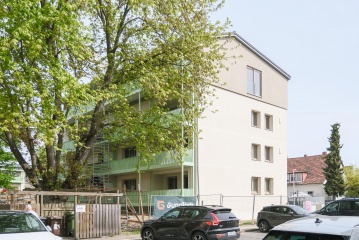
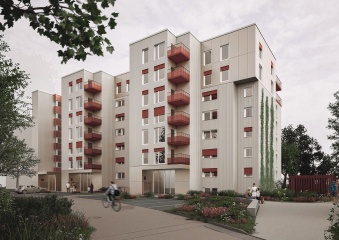
    The recyclinghouse is an experimental residential building in the Hanover district of Kronsberg. It is a prototype that tests the possibilities and potentials of various types of recycling in the real laboratory and shows a cycle-oriented and resource-saving planning approach.

    On the one hand, the recycling center relies on recyclable building products, such as the raw construction made of glue-free solid wood elements. On the other hand, recycled materials such as the foundation made of recycled concrete or wall insulations made from old jute bags are used. There are also large quantities of used components being used which, if possible, originate from the building stock of the client GUNDLACH or have been obtained locally. Particularly important is a recycling-fair design that allows the use and disassembly of the components without loss of quality or a sorted separation of the materials after the end of life.

    The construction industry is one of the largest waste producers and consumers of resources and a significant contributor to global CO2 emissions. When planning buildings, today it is mainly the energy consumption in the operation of a building that is considered. The considerable amounts of "gray energy" involved in the production of buildings remain largely unconsidered. Here, the existing building stock can also be understood as huge raw material storage. The recycling of building materials and materials as well as recycling-friendly construction methods will play an increasingly important role in the future.

    completed
    2019
  • ecovillage - Tiny Living, Hanover

    Sufficiency means shared luxury.

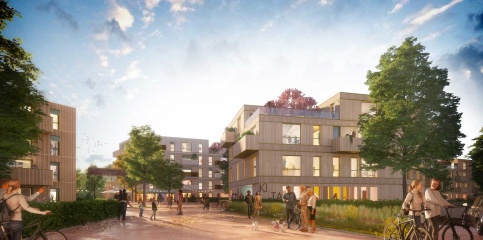
    The "Tiny Living" building is part of our project ecovillage in Hanover. It is located at the transition between the centre and the Green Ring and forms the interface between the intimate neighbourhood and communal space with a high degree of publicity.

    The L-shaped building consists of two stepped structures, which are accessed and connected via a generously usable arcade. On the one hand, the arcade enables a diverse exchange between the residents and, on the other hand, a very high degree of flexibility in the use of the building. Based on a grid, a wide variety of apartment sizes and forms of living can be offered and the living space can be adapted to future changing needs.

    The main focus in the development of "Tiny Living" is residential use. This is supplemented by a shared bicycle and storage room, two laundry rooms, a common room and an experiment room for water use and food cultivation operated by the entire ecovillage with access to the adjacent aquaponics greenhouse.

    Responsible use of building materials makes a significant contribution to the sustainability of the property. As early as the construction of the building, the conservation of natural resources is included through a design that is suitable for recycling. Through the targeted choice of materials and the possibility of a clean separation of the elements used, the amount of waste is reduced and the rate of reuse and recyclability increases. The greatest possible use of the renewable building material wood not only minimizes the CO2 emissions during the construction of the building but also serves as important CO2 storage.

    With the development of our ecovillage project in Hanover, there is a great opportunity to make an important contribution to future-oriented urban development with a balanced triad of social, ecological and economic sustainability. Find out more here.

    in progress
    2021
  • Schamotte Quarter, Bonn

    From a factory site to a green living quarter!

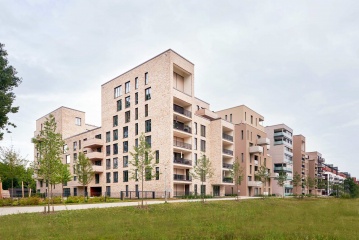
    The concept for the area of ​​the former fireclay factory in Bonn-Duisdorf transforms the industrial site into a green neighbourhood with a high quality of living. The urban arrangement of the buildings is derived from the noise impact from the south and the location within a larger city block. A four-storey block building with a stagger along the railway line shields the quarter from the noise. Two polygonal, four-storey solitary buildings in the south form the transition to the more loosely arranged buildings in the area. The structurally identical buildings fit into their surroundings by being twisted against each other and creating diverse and exciting spaces through recesses and bends.

    A neighbourhood square is being created that will serve as an identity-forming address and meeting point. An additional green open space stretches to the east, where the opposite entrances to the buildings are located.

    All adjoining municipal and private plots of land in the east and west can be integrated into the urban picture. The existing building, a shelter for the homeless, can be retained and further developed by adding another story and balconies. The green connection in the middle of the quarter will be extended and merged with a green area with a playground. In the west, a solitary structure can provide a clear edge to the neighbourhood square and minimize the noise impact on the inside of the quarter.

    All new buildings are planned as wood hybrid buildings and can be recycled and later returned to the material cycle thanks to their deconstructability. Noise protection, spatial formation, and the quality of living are not dependent on the development of the neighbouring properties, guaranteeing a functioning and green residential area.

    completed
    2022
  • High Q, Hanover

    Urban integration creates a neighborhood
    In its immediate surroundings, HIGH Q picks up on the typological and urban development characteristics of its neighborhood. The existing principles of block structures, incisions and polygonal high points are transferred to HIGH Q in order to create a harmonious overall urban image.
    On the west side of the construction site, a neighborhood square with outdoor gastronomy will be created at the interface between the office and the hotel, creating a lively meeting place for everyone. This square also serves as an entrance to the hotel lobby.

    Striking appearance creates identity
    Whether viewed from a passing train, as a pedestrian or from a bicycle, the HIGH Q always looks different and yet is unmistakable. The special façade design with 6 partial façades makes the high-rise appear slender and without a rear side, creating ever new impressions.

    Recognition value and an identity-creating design are an important requirement for this building in this exposed location. On the one hand, the façade and the striking shape create a variety of impressions depending on the viewing angle, while on the other hand the building also offers diverse and special situations in its immediate context. The undercut to Celler Strasse with its forecourt forms a clear address, the neighborhood square offers a common center for the neighborhood and the differently designed facades improve orientation and create different places.

    Idea
    2024
  • VIERZIG549, Düsseldorf

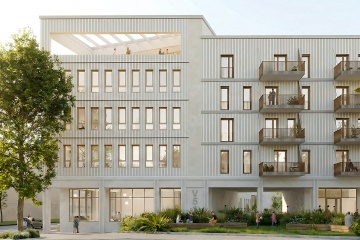
    Building 1.7 is part of the VIERZIG549 neighborhood in Düsseldorf's Heerdt district and, together with the adjacent buildings, forms the southwest entrance to the neighborhood on Willstätterstraße.

    The design aims to combine residential, office, and commercial spaces within a single building, thereby promoting social diversity and a vibrant neighborhood structure. The plan includes office space, condominiums, and commercial units featuring restaurants and retail stores. From an urban planning perspective, a compact perimeter block with an inner courtyard is created, opening up to the neighborhood square while also offering semi-private open spaces for residents and users.

    The building will be constructed as a hybrid timber structure with a wooden façade and a clearly defined base floor. Office and residential areas differ in their façade design but remain part of a unified ensemble.
    In addition to an underground garage with parking spaces and bicycle storage rooms, green retention roofs, photovoltaics, and geothermal heating are planned. The goal is a sustainable building with DGNB Gold certification, Efficiency House 40 standard, and a high quality of life through the interplay of architecture, open space, and mixed-use development.

    under construction
  • Istropolis, Bratislava

    The transformation of Trnavské Mýto into a dynamic cultural and urban hub is entering its next phase. With the building permit secured, Istropolis—designed by CITYFÖRSTER and KCAP in collaboration with Immocap—will break ground in summer 2025.

    The project will introduce a state-of-the-art concert and congress hall, modern residences, and high-quality office spaces. The 3,000-person venue will host diverse cultural and business events, featuring in-the-round seating and multi-event flexibility. Offices will include a grand atria and flexible workspaces, while the residences will be nestled within green courtyards and pedestrian-friendly streets.

    Istropolis sets new standards in sustainable urban development, integrating passive climate solutions, energy-efficient design, and biodiverse public spaces with 147 trees, 70 local plant species, and dedicated cycling infrastructure. Long overlooked despite its central location, Trnavské Mýto will soon be revitalized with green promenades, fountains, and a lively public square, supporting markets, gatherings, and everyday life.

    With construction set to begin, Istropolis moves from vision to reality, shaping the future of Bratislava through architecture, sustainability, and vibrant public life.

    in progress
    2025
  • Conversation Seelhorst, Hanover

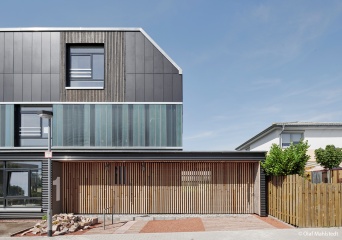
    Seelhorst is a 1960s linear housing estate on the outskirts of Hanover. The residential ensemble developed by Gundlach comprises 130 apartments in 11 buildings and is characterised by a woodland-like atmosphere, which is currently disrupted by sealed parking areas and garage structures. The project aims to energetically modernise the existing buildings, create additional housing and at the same time preserve the green identity of the neighbourhood. Cost-efficient, climate-friendly measures secure long-term affordable housing and counteract gentrification. Implementation takes place in phases while the buildings remain occupied.

    Densification is achieved through vertical extension. The existing settlement and building typology, generous green spaces and the characteristic tree stock are preserved. Previously unused attic spaces are dismantled and replaced by shallow-pitched, asymmetrical gable roofs. The extension integrates seamlessly into the existing building structure and, together with the refurbished façades, forms a coherent new architectural unit. The overall urban appearance is maintained.

    The buildings are extended by one additional storey using fast, low-noise timber construction, creating 50 to 60 new apartments. Structural loads are transferred into the existing building framework, avoiding major interventions in the original structure. The new roof surfaces are largely covered with photovoltaic modules. A prefabricated balcony structure extends the living spaces and significantly improves the quality of the existing apartments. The façades are upgraded with biogenic cellulose blow-in insulation, while the balcony structures are designed as steel constructions.

    Overall energy demand is significantly reduced. Space heating is provided by air-to-water heat pumps, while domestic hot water is supplied via electric instantaneous water heaters.

    The new apartments introduce a diverse housing mix and respond to demographic change. In parallel, open spaces are upgraded and a future-oriented mobility concept is integrated. Existing trees are preserved, sealed surfaces are removed, and additional planting improves the microclimate, stormwater retention and biodiversity.

    under construction
    2025
  • Residential Crown Windmühlenstraße, Hanover

    The residential crown is a prototype of settlement 2.0. Rooftops of retail and office buildings, as well as parking garages, are activated, attractive locations are opened up, existing infrastructures are used more efficiently and the mixture of programs in the city centre is improved. The existing parking garage is complemented with penthouses as part of the renovation of the façade and entrance area. These residential units distinguish formally from the existing building structure and simultaneously give the building a harmonious completion.

    Entrances and circulation of the building have been reorganized so that independent addresses for the car park and the residential building are clearly recognizable. The residential building is accessed (barrier-free) via a representative lobby on the ground floor with exclusive elevators that lead directly to the central, landscaped residential courtyard. The residential units are accessible from this common space. Each apartment (50 to 120m²) has a spacious, private terrace overlooking the rooftops of the city.

    completed
    2015
  • Pelikan Mix⁴, Hannover

    The project PELIKAN MIX4 is characterized by a variety of dwelling types according to urban lifestyles. Within an urban master plan four distinctive characteristics are developed:
    A landscape tableau is the connecting element, forming an entrée for the private, semi-public and public spaces. Generous lobbies in each house compose a discrete identity and a space of encounters. A great flexibility in the floor plans allows a variety of different apartments in size and type. According to society demands, the types "wellness", "sustainable", "extravagant" and "comfortable" are developed. They differ in constellation of rooms, material, building equipment and the offer of outdoor spaces. So called "Glorietten" crown the buildings and optimize light, spatial peculiarity and views.

    completed
    2016
  • Integrated Comprehensive School Langenhagen, Langenhagen

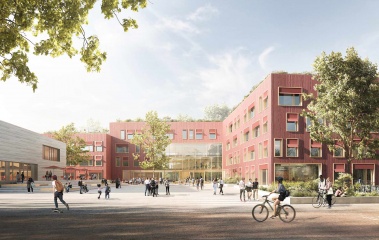
    With the new building respectively renovation, IGS (Integrated Comprehensive School) Langenhagen is changing from a school location with many buildings and addresses, separate uses and not barrier-free routes to an inclusive landscape of shared learning in close contact with the city and nature. Learning clusters with classrooms, differentiation areas and mixed-use recreation areas are organized around a central common centre and thus offer a variety of places to learn, linger, communicate and relax.

    The new school building is located at an urban node. While the south is characterized by loose and urban development and large-scale centre functions, the north is a green recreational area with old trees, green meadows and biotopes close to the water. The new structure mediates between these two worlds and creates a clear, urban address in the south as well as a central schoolyard in the north, which turns into a landscape park.

    Together with the existing cafeteria, the school building takes up a clear and public space. This is the place to arrive and linger for students, teachers and visitors. Supported by the large terrace of the cafeteria, this creates a lively space. The square is in close spatial connection with the newly designed bus stop, the bicycle parking spaces and the town hall square on the opposite side of the street. In the north, the structure interlocks carefully with the school park. Between the new building and the refurbished creative pavilion, there is a lively, enclosed, green break room, which connects the existing buildings (sports halls and creative pavilion) in an east-west direction. The compact building cubature maximizes the preservation of the existing trees and minimizes surface sealing.

    The building is designed as a wood-concrete hybrid construction. Optimal sun and glare protection while maximizing the use of daylight is guaranteed by blinds that align automatically depending on the amount of sunlight.

    completed
    2021
  • Gymnasium Lutherschule, Hannover

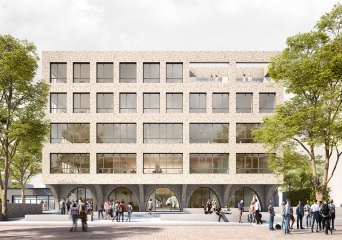
    The draft envisages an extension of the Lutherschule through a powerful and independent structure, which fits into the existing block structure and self-confidently positions itself to the Engelbosteler Damm.
    The five-storey building forms in a modern and contemporary architectural language a clearly perceptible address while radiating openness and transparency. At the same time, the indented ground floor facade with its striking brick arches creates a spacious and covered entrance area.


    The central organizational idea is the clustering and self-evident stacking of the different areas of use:
    The communal areas are located on the ground floor, the creative areas on the 1st floor, the natural sciences on the 2nd floor and the grade clusters on the two upper floors. As in the floors below, the classrooms are grouped around a central communication zone that creates additional learning venues with niches and open areas.


    Idea
    2018
  • Campus Nümbrecht, Nümbrecht

    The Nümbrecht School Centre is to be restructured in several construction phases and thus converted from a classical corridor school with internal, anonymous and unused corridors into a new spatial-pedagogical concept, the Cluster School.
    The corridors will be activated and transformed into communication zones, supplemented by group / EVA rooms and team stations, as well as niches and self-study areas, and opened to the communication zone.

    In order to maintain a clear location of the gymnasium and the secondary school after the merging of the Hauptschule and Realschule to form the secondary school, the former Hauptschule will be demolished and the school centre supplemented by the new building of the secondary school. The planned new building contains 18 classes, 3 team rooms and 12 special learning rooms, which are grouped together in clusters.
    The central interface between the existing building and the new one is the "common centre", which ensures the connection of the new building to the existing school centre.

    under construction
    2019
  • O.A.S.E., Stuttgart Rosenstein

    As the entrance to Stuttgart's new main station, the A3 development site plays a special role in the urban fabric. In a location that, more than almost any other, symbolises transformation and public consultation processes, the open public competition 'Raum für Ideen' (Space for Ideas) highlighted what is missing from the future city centre: a consumption-free, weather-protected yet open space for the urban community.
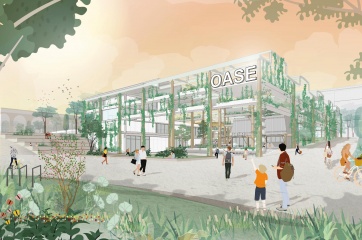
    With the O.A.S.E., we propose a social innovation hub here as public-benefit-oriented infrastructure – an Open Appropriation and Social Development Space that functions as a climatic and social oasis.
    The reused supporting structure of the historic station canopy provides an overarching framework, beneath which a permeable fabric of open space and buildings emerges. In this sheltered interior, leisure and activity converge: people can simply be here, strike up conversations, initiate projects, develop them further together and test them in practice. Workshops, open learning and exchange spaces, as well as venues for display and presentation, intertwine to make social issues visible and negotiable.
    This creates a new urban space that not only offers shelter and a pleasant environment, but also acts as a catalyst for exchange, participation and collective action, and supplements the city centre with a public infrastructure that has been lacking until now.

    Idea
    2026
  • "Waldhäuser" East, Tübingen

    The Waldhäuser Ost housing estate, built in the 1970s, is undergoing comprehensive energy efficiency upgrades and careful redevelopment. The location of the building in an earthquake zone poses a particular challenge, as it does not allow for classic building extensions under normal static conditions. The necessary earthquake safety is therefore achieved through targeted measures to reinforce the building: Reinforcing balcony walls and additional northern extensions take on load-bearing functions and at the same time enable the creation of additional living space.

    Two of the three building sections will be extended using lightweight timber construction. This method reduces the dead weight of the structure while also meeting high standards of sustainability and cost-effectiveness. In order to retain the existing residents in the long term, the energy-efficient renovation of the facade will be deliberately limited to the necessary extent. Serially manufactured, recyclable components are used; openings and balconies are based on the existing building in terms of scale and appearance. In this way, structural improvements can be made without triggering a noticeable increase in rent.

    The energy efficiency upgrade of the building envelope is combined with an extension of the balconies and a new, contemporary color and facade concept. In addition, northern extensions, additional stories, and the conversion of the existing ground floor and garden level apartments into maisonette apartments for large families will significantly expand and diversify the mix of apartments.

    More generously designed outdoor seating areas and improved outdoor spaces also enhance the quality of life and strengthen the overall quality of living in the neighborhood.

    Idea
    2025
  • Industrial building Barsinghausen

    A new company headquarters for the development and production of machine parts is being planned in Barsinghausen. The compact new building is designed to create optimal conditions for good internal communication between the work areas, thereby promoting the company's innovative strength.

    The skeleton construction allows for a combination of large open production areas and flexible office layouts. A comprehensive climate and energy concept in accordance with the KFW 55 standard provides for a geothermal heat exchanger under the building and photovoltaics in combination with a retention roof with an adjoining cistern and pond.
    As part of the social concept, the building offers the workforce a bistro area with outdoor seating and a landscaped roof garden to support informal communication and working methods and provide space for relaxation.


    completed
    2019-2024