ul class="overview_list " id="projectList">
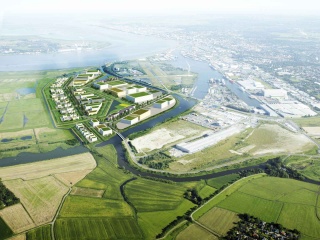
  • Lune Delta°... designed as closed-loop cycles, Bremerhaven

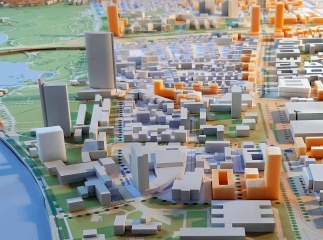
    Taking into account the Cradle to Cradle philosophy, the Lune Delta forms an economic structure that provides design, ecological and social contribution even after the end of its period of use. The sustainable commercial area is based on the following principles: 1. integral: The structure fits into existing overall structures, arises and also benefits from them. 2. demand-oriented: Different requirements are covered by the initial cluster. The system of ditches forms its own ecosystem and areas for Commons are implemented. 3. diverse: Open space systems and the special sector mix resolve the contradiction between commercial use and landscape and contribute to creative and social diversity. 4.circular: Buildings, open space and infrastructures operate as material cycles. They support technical or biosphere principles and adapt functionally and in design. 5. sustainable: The use of renewable energies is a hybrid system, which is locally, infrastructurally and formally connected. 6. orchestated: The cooperative Development Company Lune-Delta controls processes, ensures synergies and promotes communication.

    in progress
    2017
  • Landscape Campus, Flensburg

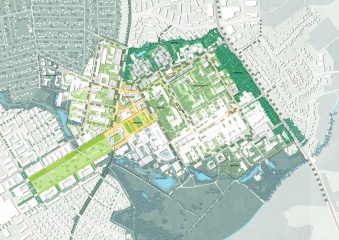
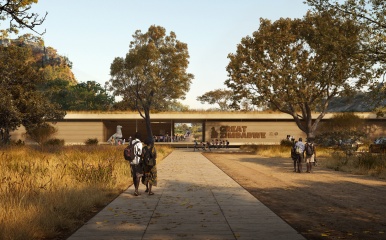
    At Campus Flensburg the landscape takes center stage. The site, which is shared between the European University Flensburg (EUF) and the University of Flensburg, features areas of dense urban structures juxtaposed against expanses of undisturbed nature. Because of its proximity to the town's centre, the campus constitutes an important site for enabling citizens' access to nature, as well as a social space and a logistical link for students. Our design acknowledges this, and despite expanding the campus to accommodate more students and add new uses, no additional land is sealed.

    The plan was developed through a cooperative workshop procedure together with our team-mates at TREIBHAUS. It embraces the different urban planning qualities of the two universities and the connecting landscape park as well as the needs of all stakeholders, locating shared facilities for all users at the heart of the campus. A central element of the design is the campus loop, which serves as an important pedestrian route across the campus while also facilitating orientation. This path is complemented by the garden loop, a greener route creating connections to the open spaces and the surrounding area.

    The overall campus design observes holistic principles of sufficiency and circularity; requirements for buildings, infrastructure and parking spaces are critically scrutinised, while sustainable mobility and energy solutions go hand in hand with integrated design to ensure that resources are efficiently shared and reused. The consistent development of ground-level parking and a strategy of redensification preserves the defining quality of the campus to be preserved - its green, open landscape.

    in progress
    2024
  • Framework plan federal district of Bonn, Bonn

    In recent years, the Bundesviertel in Bonn has transformed into a successful business location and headquarters of the United Nations. Today, the district in the former federal capital faces new challenges to remain and become attractive as a location for companies, politics, international institutions and congresses and at the same time as a 'piece of the city'. The aim of the framework plan is therefore to show an integrated approach for future development.

    One of the main goals of the structural concept is to preserve and strengthen the identity-creating areas and to develop the inner potential areas structurally and openly in a sustainable manner. With the increase from currently around 4,000 to around 15,957 inhabitants, new needs arise in terms of supply and socio-cultural infrastructure.

    The Bundesviertel of the future is urban mixed, offers affordable and attractive living and working space, is characterized by social and cultural, sports, leisure and supply offers as well as high-quality open spaces. Through more and a variety of living spaces, commuters become residents. As a sustainable location, the Bundesviertel is changing from a simple office location to a work landscape ('work-life blending'). A crisis-proof and innovation-promoting mix of industries offer employees an attractive working environment.

    The concept is rounded off by a high-performance transport infrastructure that guarantees quick accessibility and good internal networking: An important role model for the traffic turnaround: cycle paths and footpaths are being greatly expanded and public transport is being strengthened.

    completed
    2022
  • Campuswelten, Lübeck

    In addition to the university, the campus is also home to the Technical University, the University Hospital Schleswig-Holstein and other research institutions. In the course of the redesign, strategic guidelines were developed to steer the growth into a cohesive campus. The focus was placed on the development of existing structures and the preservation and qualification of green spaces. The development strategies are independent of each other in terms of content and time and can react flexibly to unforeseeable events.

    The profiling of characterful subspaces provides orientation in the placement of new functional modules, creates synergies between them and serves orientation within the campus through recognisability. In addition to high-quality places of arrival, a knowledge path creates clarity in the circulation of the quarter.

    In order to become an independent, lively district, the aim was to intensify use through residential uses and community facilities. Underused places are activated and reprogrammed. The sense of belonging to the city is reinforced by numerous links with the surrounding area. Existing barriers such as fences are removed.

    in progress
    2022
  • Düsseldorf Mosaic, Düsseldorf

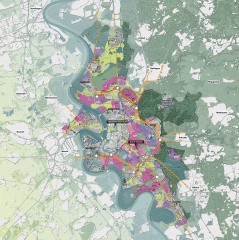
    How can Düsseldorf react to demographic change? Who plays which part in current urban development processes? Where can we create affordable living space? How far away is the open countryside, the nearest playground? These and many other questions concern the citizens of Düsseldorf. The "Raumwerk D", which is being developed parallel to the "Mobility Plan D", is intended to provide answers to such questions that have been worked out together. The spatial image determined within this framework is not a plan in the conventional sense. It is based on the current state of urban and landscape spaces and emphasises structural elements. It marks identity-defining places as well as urban structures that take over important functions for orientation. Furthermore, it spatially and pictorially highlights the qualification and profiling of urban spaces and the focal points of urban development. The participants in the dialogue process have enriched and specified the spatial image with suggestions regarding content and illustration.

    in progress
    2019
  • Carbon-Based Design

    How can we ensure that the 1,000,000 new homes that are needed in the Netherlands before 2030 exert as little pressure as possible on the already difficult-to-achieve climate targets? Even if all future homes are built according to the current agreements (BENG [nearly energy-neutral building], and 4% emission reduction in the industry), the CO2 budget for construction (under a 1.5-degree warming scenario) will be used in 2026 already.

    As the construction sector, we are currently responsible for 38% of all greenhouse gas emissions. The problem is definitely gaining momentum in the debate; however, the focus within our professional community seems mainly to be on single methods or materials - whereas the solution lies in an integral approach.

    Carbon-Based Design is this approach. It provides insight into the CO2 cycle and what role the construction sector and the circular construction economy play in it. The focus is on embodied carbon (or material-related emissions during the production and construction process) in residential construction. By gaining insight into the construction process and which parts of it have the most impact on the total emissions, we can adjust our design and development strategy accordingly. The aim is clear: to design and realize buildings with the lowest possible CO2 emissions, or ideally even CO2 storage.

    With a focus on the emissions of production and construction and the ratio of operational and embedded energy, we found solutions for the way from carbon exploitation to carbon sequestration.

    completed
    2021
  • Schamotte Quarter, Bonn

    From a factory site to a green living quarter!

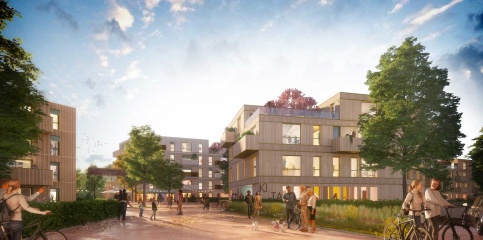
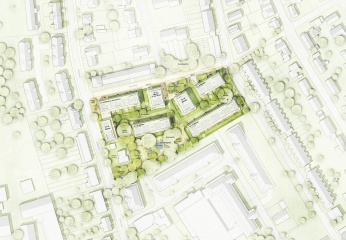
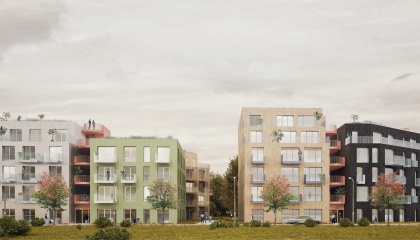
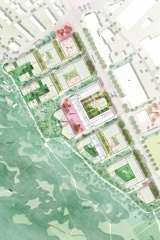
    The concept for the area of ​​the former fireclay factory in Bonn-Duisdorf transforms the industrial site into a green neighbourhood with a high quality of living. The urban arrangement of the buildings is derived from the noise impact from the south and the location within a larger city block. A four-storey block building with a stagger along the railway line shields the quarter from the noise. Two polygonal, four-storey solitary buildings in the south form the transition to the more loosely arranged buildings in the area. The structurally identical buildings fit into their surroundings by being twisted against each other and creating diverse and exciting spaces through recesses and bends.

    A neighbourhood square is being created that will serve as an identity-forming address and meeting point. An additional green open space stretches to the east, where the opposite entrances to the buildings are located.

    All adjoining municipal and private plots of land in the east and west can be integrated into the urban picture. The existing building, a shelter for the homeless, can be retained and further developed by adding another story and balconies. The green connection in the middle of the quarter will be extended and merged with a green area with a playground. In the west, a solitary structure can provide a clear edge to the neighbourhood square and minimize the noise impact on the inside of the quarter.

    All new buildings are planned as wood hybrid buildings and can be recycled and later returned to the material cycle thanks to their deconstructability. Noise protection, spatial formation, and the quality of living are not dependent on the development of the neighbouring properties, guaranteeing a functioning and green residential area.

    completed
    2022
  • Új Rákosrendező, Budapest

    The Rákosrendező Masterplan is a transformative 244-hectare brownfield redevelopment in the heart of Budapest, including a 148-hectare action area, redefining one of Europe's most significant urban regeneration sites.

    In collaboration with Coldefy, Treibhaus, Spora Architects, and Markó & Placemakers, the project was awarded First Prize in an international competition commissioned by the Budapest Capital Asset Management Centre on behalf of the Municipality of Budapest.
    The proposal introduces over 10,000 new homes alongside commercial, civic, and recreational spaces, all structured around the principles of the 15-minute city. At its core lies the existing railway landscape, reimagined as a defining spatial framework that supports mobility, long-distance views, and a network of public parks. This backbone is complemented by a system of interconnected green and blue corridors, enhancing ecological performance while creating attractive, accessible public spaces.
    The new district is organised into six distinct neighborhoods, each with its own identity and local centre, anchored by a central mobility hub around a new train station. This structure enables flexibility, accommodating diverse lifestyles, household types, and future urban dynamics. A strong emphasis is placed on high-quality public space, with a sequence of key green areas- including a railway park, the large forest park, and a sports park- linked by a continuous north–south green axis.
    The plan will convert the long-neglected railway area on the Pest side, over the next 15 years, into a European benchmark of sustainability- lively, mixed-used and landscape-driven.

    in progress
    2026
  • VEEDL4, Cologne

    VEEDL4 creates a vibrant piece of city: dense, diverse, and well connected. Open spaces, buildings, living, and working are closely intertwined, forming a strong whole centered around community. Many amenities are shared, distances are short, and daily life can be organized locally. At the same time, the surrounding neighborhood benefits from new connections, public spaces, and shared facilities.

    The design consciously builds on the existing site. A distinctive high-rise element at the entrance on Brühler Straße combines key functions such as daycare, healthcare services, and local retail. Behind it, the neighborhood opens up with the preserved existing building, the VEEDL Café, and the lively central space known as the VEEDLHerz. More quietly positioned is the residential courtyard, offering a protected retreat for residents.

    A continuous green corridor links all parts of the development and connects it to the surrounding area. The VEEDL Park, the lively center, the green pathway, and the quiet courtyard together create a diverse network of open spaces. New pedestrian routes improve connections to schools, public transport stops, and adjacent residential neighborhoods. Trees, green areas, and permeable surfaces also improve the local climate and support on-site rainwater infiltration.

    Living and working are closely connected. Spaces for healthcare, crafts, small businesses, and creative work are combined with a variety of housing types. The compact apartments are complemented by shared amenities, creating more space for everyone without consuming additional land.

    The district is designed primarily for people: everyday journeys can be made on foot or by bicycle, while car traffic is reduced and efficiently organized. The buildings are simple, flexible, and adaptable to future needs.
    Idea
    2026
  • Refurbishment Zeissig, Völksen-Springe

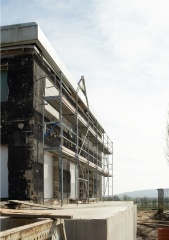
    The office building of the Zeissig company dates back to the 1960s. In the 1990s, an extension and an additional floor were added and inaugurated in 1991. The entrance façade and the glazed extensions on the western and northern sides of the office building have aged considerably and exhibit a low energy performance as well as an outdated architectural appearance.
    Over the years, the existing solid-construction building has undergone several alterations, resulting in an inconsistent architectural expression both internally and externally. As a consequence, the building currently appears fragmented and visually incoherent.
    The aim of the project is to renew the public appearance of the Zeissig company, create additional floor space and at the same time establish a clearer spatial structure within the existing building. In addition, an energy-efficient modernisation of the building is planned.
    As part of the project, the single-floor glazed extension on the north and west sides of the existing building will be removed due to energy and functional requirements. In its place, a two-floor timber extension is planned in order to provide additional office space and achieve a more efficient use of the site. The existing building and the new extension will receive a shared ventilated rainscreen façade.
    A key design focus lies in strengthening the building's address towards the west. In order to create a representative entrance area, the extension of the office building will receive a recessed entrance zone. In front of this entrance area stands the existing "Eichenhammer" sculpture, which will be integrated into the entrance ensemble.

    under construction
    2019-2026
  • Charloisse Kerksingel, Rotterdam

    Open, Old and New

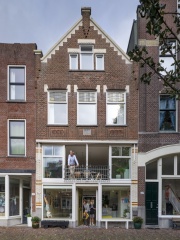
    This 1893 home in Oud-Charlois is a former part-art gallery part-house transformed into a bright, spatial three-story living environment. Designed to balance the constant bustle of family and work life, the house embraces openness across four stories, allowing for collectiveness while accommodating multiple uses.

    On the ground floor, the building's past as a workspace is still evident. It once served as a private office, with a meeting room set in a hall lined by large street-facing windows. A bar—made from the half-height wall that the former gallery owners used in their bathroom—anchors the space. Behind this, through a sliding door, lies a quieter work area with a library and a large meeting table that used to be space for eight workstations. Toward the back, the layout has been adapted into a self-contained studio with a kitchenette, bathroom, and sofa.

    The first floor forms the heart of the home. Arranged around a central opening, it allows views down below and strengthens the sense of spatial continuity. Here, the kitchen and main living areas are located, where openness brings in daylight and maintains a visual connection between family members, as well as between the indoors and outdoors throughout the day. A partly taken out floor creates space for a loft with a guest room, living room and open bathroom on the first and second floor.

    Upstairs on the third floor, the former layout has been reconfigured. What was once a single large bedroom with an open bathroom—separated only by a half-height wall—has been transformed into a more articulated family arrangement, including the children's bedrooms and bedsteads. With parts of the past aiding the renovations of the present, this building fosters a perfect mix of familiarity and modernity in a home.

    completed
  • O.A.S.E., Stuttgart Rosenstein

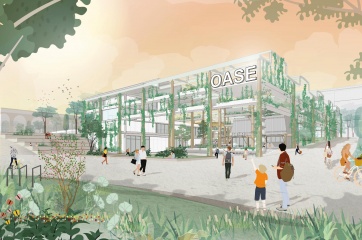
    As the entrance to Stuttgart's new main station, the A3 development site plays a special role in the urban fabric. In a location that, more than almost any other, symbolises transformation and public consultation processes, the open public competition 'Raum für Ideen' (Space for Ideas) highlighted what is missing from the future city centre: a consumption-free, weather-protected yet open space for the urban community.
    With the O.A.S.E., we propose a social innovation hub here as public-benefit-oriented infrastructure – an Open Appropriation and Social Development Space that functions as a climatic and social oasis.
    The reused supporting structure of the historic station canopy provides an overarching framework, beneath which a permeable fabric of open space and buildings emerges. In this sheltered interior, leisure and activity converge: people can simply be here, strike up conversations, initiate projects, develop them further together and test them in practice. Workshops, open learning and exchange spaces, as well as venues for display and presentation, intertwine to make social issues visible and negotiable.
    This creates a new urban space that not only offers shelter and a pleasant environment, but also acts as a catalyst for exchange, participation and collective action, and supplements the city centre with a public infrastructure that has been lacking until now.

    Idea
    2026
  • Nad Kaminkou, Zbraslav

    With the design for a new residential area in Nad Kamínkou, we see development not merely as the provision of housing, but as a catalyst for the sustainable transformation of the entire neighbourhood. Our aim is to convert what is currently a car-oriented and fragmented site into a vibrant, green and excellently connected district that brings together the urban energy of Prague and the landscape and scenic qualities of Zbraslav, serving as a role model for future neighbourhood developments.
    The masterplan combines the potential of the busy Elišky-Přemyslovny Street with the extensive, green Borovičky Park. At the western entrance to the neighbourhood, a mobility hub serves as a clear landmark with a lively public square, making a strong urban statement. It enables convenient transfers between car, bus, bicycle and pedestrian traffic and marks the transition to a lowtraffic residential environment. To the east, the park forms a green counterpole with generous areas for nature, sports and recreation.
    The neighbourhood mediates both spatially and functionally between these two poles, balancing urban intensity and landscape openness while offering a careful interplay of privacy and permeability. Three green axes structure the area: a communal north axis with a square, orchard and gardens, a blue-green axis with visible rainwater management, and a green boulevard in the south. The architecture follows this logic: Terraced block structures define clear spatial boundaries and lively ground floor areas, while detached city villas create create a smooth transition to the park. Shared courtyards connect architecture and open space.

    Idea
    2025
  • Elisabeth-Aue, Berlin

    The new Elisabeth-Aue neighborhood combines a high proportion of modular housing units with a diverse urban structure. It is based on a flexible framework that, through its spatial and landscape design, creates diverse, climate-adapted spaces offering a high quality of life. The central "Elisabeth-Meile" with tram access structures the neighborhood in a north-south direction, while two green-and-blue open-space axes running east-west integrate the surrounding landscape areas and create additional structure.

    A total of approximately 5,000 residential units will be created, predominantly in 5–6-story buildings with select architectural accents. Generous building plots with unpaved, green courtyards, as well as complementary building types and mixed-use developments, ensure a diverse range of housing options. The center, featuring a neighborhood square, local amenities, commercial space (approx. 30,000 m² gross floor area), mobility options, and social facilities, forms the vibrant heart of the district.

    The open space concept aims to create a climate-adapted urban space with a low degree of paving (approx. 30%) and multifunctional green spaces for rainwater management, biodiversity, and recreation. Overall, the result is a sustainable, resilient neighborhood that serves as a model.

    Idea
    2025
  • New Center Silberstedt

    With the New Centre, Silberstedt is gaining a strong, identity-forming centre that reorganises public services and further develops the town from its existing stock. Education, health, culture, housing, utilities and mobility are spatially bundled and linked together via short distances. This creates a neighbourhood suitable for everyday use and suitable for all generations, bringing together the basic functions of village life at its core. The starting point is the careful conversion of a landmark building from 1886. Instead of new construction, the concept focuses on further building: existing structures are preserved, repurposed and activated with new functions. The community centre, village office and village canteen create space for clubs, work and encounters – resource-saving, economically efficient and firmly anchored in the history of the place. The existing buildings remain an anchor that creates identity and become the driving force behind development.

    A clearly structured open space system unfolds between the village square and the village park. The square forms the urban stage for markets, festivals and exchanges, while the park, as a green centre, combines local recreation, play, sport and biodiversity. At the same time, it takes on a climate-adapted function as a retention area during heavy rainfall.

    The centre is complemented by a community swimming pool, a cross-generational residential quarter and the upgrading of the school and kindergarten. Barrier-free paths, new bus stops, sharing services and bicycle parking spaces strengthen the sustainable mobility.

    Idea
    2025