ul class="overview_list " id="projectList">
  • Quarter at the Propsthof, Bonn

    mixed, interconnected, green

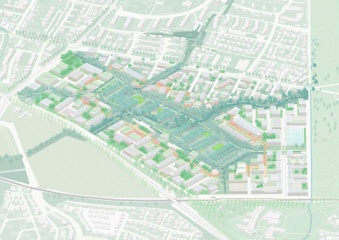
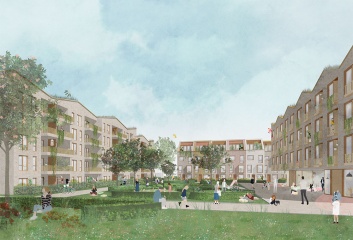
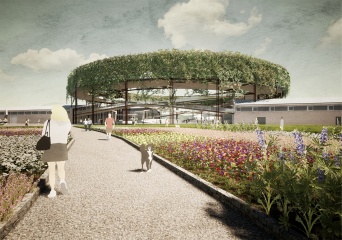
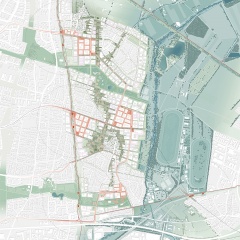
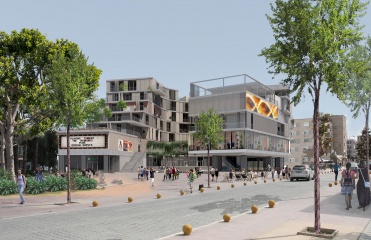
    The quarter at the Propsthof forms an important component of the development area "west.side" in the west of Bonn. The property, which, due to parking spaces and low buildings is underused today, is to be developed into an attractive and mixed quarter with residential and office uses in the future.

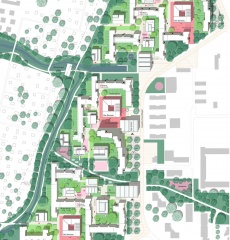
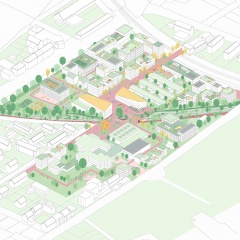
    The proposed urban configuration fits into its surroundings and, as an entrance, creates new connections to the neighbouring quarters, especially for pedestrians and cyclists. The entrance to the district at the Propsthof is staged by creating a gate situation. Two seven-storey buildings with commercial use and active ground floor zones emphasize the entrance in terms of urban planning and structural engineering. A generous open space leads into and through the quarter.

    The residential quarters adjoining to the west are given a counterpart at the Propsthof, which complements the urban figure and forms quiet inner courtyards. As the centre of the district, the "mile" and the district square create a sequence of open spaces in which residential and commercial use meet.

    Existing green structures are integrated into the open space structure. The natural design of the open spaces reduces the degree of sealing of the property, promotes biodiversity and has a positive effect on the microclimate. The sequence of rooms, from the green neighbourhood squares to the residential courtyards, reacts to the contemporary demands of urban living and working.

    completed
    2022
  • Mühlenleine, Hannover

    A river in the middle of Hannover's city center holds the potential to be an inviting, green place where city dwellers enjoy spending time. Currently, valuable areas along the Leine's shores between the river and the Cityring are neglected and underused.

    In pre-industrial times, the Leine and its tributaries were among the river systems in northern Germany which had the highest quantity of salmon. During industrialization and the resulting pollution of the water bodies many fish species have disappeared. The reduction of the fish stock is linked for example due to the construction of hydroelectric power plants and dams, and the large-scale river development carried out in the 20th century.

    Numerous projects since the 1970s have restored and improved the water quality and the ecological connectivity. The renaturation of rivers is an important contribution to a resource-efficient and ecological city.

    In the confined spaces of a city, a particularly large number of different demands are placed on water bodies. However, numerous potentials along the Leine remain unused in the inner city. Further, the canalization and urbanization of the stream only allows to a limited extend the return of flora and fauna to the city. Renaturalised rivers in the city can help to cushion the effects of climatic changes. For example, riparian areas can be integrated into flood protection by retaining the water during periods of extreme rainfall. In addition, the design addresses urban planning goals, such as making the river shores more attractive and easily accessible for the citizens.

    Since the Leine is an urban river, it ought to be addressed both in ecological as well as in social terms. Various interventions along the riverbank serve to revitalize and enhance the quality of life. The key part of the project are the renaturation of shore opposite to the "Hohes Ufer", the reduction of the cityring and the fish ladder. In these areas, new habitats for flora and fauna are created along with new places and functions for recreation. The fish ladder close to the Friederiken Bridge, will enable the connectivity and improvement of existing habitats and it will increase the visibility of the Leine in the city as a unique selling point.

    The concept for the renaturation of the Leine was presented on the 29the of September 2022 with the Leinewelle e.V. and Angler Association and published in the Hannoversche Allgemeine Zeitung (HAZ), among others.

    Idea
    2022
  • Unusual living KIDS, Bremen

    In Germany, 90% of all children live in cities - 60% in large and medium-sized cities alone.

    The concept study takes this as an opportunity to redesign the existing housing estate on Bürgermeister-Reuter-Straße in Bremen Vahr according to the principles of a child-friendly city. The settlement shows various potentials in open space as well as in the building stock. In addition to the location on Lake Vahr, the rich tree population and the generous open spaces, the sealed parking spaces, the repetitive, underused open spaces, and the missing center pose challenges.

    In phase 0, a footbridge will be built that connects the neighborhoods with each other and interweaves the settlement with the network of paths in the area. It creates a center for the entire quarter, creates an address on Kurt-Schumacher-Allee, invites you to the quarter, and leads to the water. This is where people play, romp, rest, chat, celebrate, cook - a meeting point and link between the neighborhoods.

    The redensification strategy is subordinate to the maintenance of the valuable tree population and is divided into measures of upgrading, increasing, and adding. New forms of living promote the social mix in the neighborhood and enable new, diverse family structures and forms of living together in the long term.

    A central neighborhood garage on the main street, supplemented with decentralized mobile stations, enables a car-free neighborhood - this increases security, which at the same time brings more space to play on the street.

    The open space is made usable in the form of private gardens, neighborhood islands, playgrounds, and the "children's wilderness". The footbridge offers various areas of play - also for informal play and nature experiences.

    In the climate-neutral quarter, the roofs are activated as blue-green solar roofs. The rainwater is collected, stored, and evaporated. Biodiversity is promoted and made visible through bee pastures, hedges, and orchards. The footbridge leads as a research path through the future-oriented quarter. There, children can play close to nature and explore relationships between themselves and their environment. Sustainable use of resources can be learned in childhood.

    Idea
    2020
  • Vlora Boulevard, Vlora

    A scenic route that attracts locals and tourists.

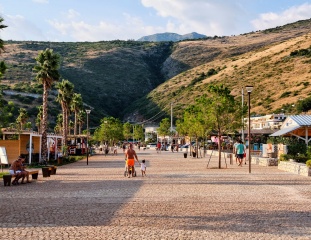
    With the new Boulevard in Vlora, the second largest port city of Albania, we vitalized an important node of the city that was far from using its great potential of becoming the lively heart of Vlora. Here one can find everything the city needs; from bars, shops, and restaurants to theatres, mosques, the University and the stadium.

    The mission was to improve the public space that now is not only the biggest shopping street of Vlora but also acts as the spine of the urban structure connecting a variety of different programs with each other. The existing mix of regional and local functions and commercial and entertainment activities, that give the street a character with a high dynamic, has been strengthened.

    The boulevard used to be dominated by speedy car traffic and was characterized by palm trees that, unfortunately, were slowly dying due to a disease if not mostly dead already. The former noisy 4 lane street got downgraded into a 2 lane street to provide a 4 m wide free space for pedestrians to stroll and to promote the use of bicycles: A new service strip for terraces, furniture and all kinds of the local greenery.

    A lot of local greenery has been added to provide shade, reduce urban heat and improve the conditions and microclimate of the city. By using local materials and plants typical for the beautiful Albanian Riviera the design celebrates the identity of Vlora and emphasizes the genius local and topographical qualities and conditions. Sustainable and resilient materials for paving, using local planting and trees, define a public space that captures the characteristics of Vlora.

    completed
    2018
  • Integrated Comprehensive School Langenhagen, Langenhagen

    With the new building respectively renovation, IGS (Integrated Comprehensive School) Langenhagen is changing from a school location with many buildings and addresses, separate uses and not barrier-free routes to an inclusive landscape of shared learning in close contact with the city and nature. Learning clusters with classrooms, differentiation areas and mixed-use recreation areas are organized around a central common centre and thus offer a variety of places to learn, linger, communicate and relax.

    The new school building is located at an urban node. While the south is characterized by loose and urban development and large-scale centre functions, the north is a green recreational area with old trees, green meadows and biotopes close to the water. The new structure mediates between these two worlds and creates a clear, urban address in the south as well as a central schoolyard in the north, which turns into a landscape park.

    Together with the existing cafeteria, the school building takes up a clear and public space. This is the place to arrive and linger for students, teachers and visitors. Supported by the large terrace of the cafeteria, this creates a lively space. The square is in close spatial connection with the newly designed bus stop, the bicycle parking spaces and the town hall square on the opposite side of the street. In the north, the structure interlocks carefully with the school park. Between the new building and the refurbished creative pavilion, there is a lively, enclosed, green break room, which connects the existing buildings (sports halls and creative pavilion) in an east-west direction. The compact building cubature maximizes the preservation of the existing trees and minimizes surface sealing.

    The building is designed as a wood-concrete hybrid construction. Optimal sun and glare protection while maximizing the use of daylight is guaranteed by blinds that align automatically depending on the amount of sunlight.

    completed
    2021
  • Kieler Knick, Kiel

    striking gate + green neighbourhood

    The area at the Waldwiesenkreisel forms an important, previously misused entrance to Kiel city centre. With the development of the property, there is now a great opportunity to formulate a distinctive entrance to the city and to create urgently needed, high-quality living and working space.

    By shielding the street noise, a quiet, green residential area is created inside the building complex, which brings the lush, northern open space into the quarter through its open design. This creates a green gem with its own identity in a heterogeneous urban environment.

    The structural composition and the landscape-architectural interventions of the mixed-used "Kieler Knick" create a concise design language. The courtyard and the roof terraces are open-space extensions of the building and form an urban meeting point for workers, residents and visitors. Based on the diverse spatial program, places of encounter and exchange are created, as well as space for retreat and peace. The interplay of the dense trees and green roofs creates a particularly pleasant climatic situation in the quarter. In dialogue with the different types of living, a wide range of open spaces is created for shared and private use.

    Additionally, Mobility is entirely geared towards the environmental network. Pedestrian and bicycle traffic are prioritized with different concepts. All necessary parking spaces for the MIT (tenants and visitors) are organized in the two separate underground garages. There are charging stations for e-vehicles as well as possible car-sharing offers in the direct vicinity of the development cores.

    completed
    2021
  • TVET campus extension Mazar, Masar-i-Sharif

    The TVET Campus Balkh consists of three different technical and vocational schools (an Agriculture and Veterinarian Institute, a Technical Teacher Training & an Engineering College) as well as student housing. The master plan for the campus extension aims to connect these three schools through common indoor and outdoor areas, to facilitate students' interaction and communication.

    The local climate was one of the main drivers behind the design. Both the placement of the buildings, the design of the facades, the implementation of shading and cooling elements and the water management of the campus have been customized to the local climate conditions to create pleasant indoor and outdoor spaces.

    A central square and the addition of trees link all main functions of the campus and create high quality outside areas. A multi-purpose hall provides the students with a facility for sports, social activities and events, while the kindergarten in the centre of the campus offers a safe environment for children to learn and play. For this kindergarten, the existing buildings of a historical caravanserai were converted. These new functions, together with the re-designed outside areas, contribute to the inclusiveness of the campus for different users.

    completed
  • Mtirala National Park, Adscharien

    Mtirala National Park is considered one of the most important protected areas in the Autonomous Republic of Adjara in Georgia. The name Mtirala (meaning „to cry") is derived from the 4,500 mm of annual rainfall, making it one of the wettest areas of the former Soviet Union.

    The Integrated Masterplan for Mtirala National Park and Korolistavi Village aims to strengthen both wildlife and ecosystem protection as well as local economic development through eco-tourism. CITYFÖRSTER in collaboration with a variety of experts, from business consultancy to mountain bike trail development, developed a masterplan by formulating a 20-year vision for the region, containing 25+ possible interventions promoting and making accessible the "wettest place of Europe" a subtropical European rainforest, as well as a detailed 3-year action plan, eco-tourism and marketing and promotion strategy.

    CITYFÖRSTER organized three workshops with the community of Korolistavi village and three stakeholder's workshops, identifying their goals and vision for Mtirala National Park and Korolistavi village.

    Regarding the Architectural interventions, we were greatly inspired by the extremely peculiar natural situation of the park. Our aim was to design an architecture that doesn't distort but rather amplifies the peculiarities. This was achieved by designing extremely light, compact, and delicate objects.The function of these objects is not to draw attention to themselves but to be used as devices for understanding their natural surroundings.

    completed
    2022
  • Humboldtblock, Berlin

    The Humboldt Block combines existing and new buildings to create a new productive quarter with a character know for Berlin, connects on many levels with its surrounding and can respond flexible on future challenges. The urban design aims to connect the area wit its surrounding - on one side the Humboldthain as an important open space, on the other side with the adjacent areas and institutions of the technology park.

    The structural setting completes the perimeter development of the building block along Gustav-Meyer-Allee. Existing and new buildings merge to form a quarter with a strong character, creating an outside view typical for the location. The part on Gustav-Meyer-Allee with its public first floor areas form the showcase, representing the new quarter. In the center of the Humboldt Block, a sequence of squares is created to connect the entrances of the new and old buildings. Those buildings face each other and form a common public space.

    The development is divided into nine north-south oriented strips of buildings, some of which are grouped together by internal courtyards. The main internal development for delivery traffic divides the resulting building strips in an east-west direction. The permeable building structure opens generously to the Humboldthain and links the quarter with its surroundings. The main thoroughfare is aligned with the two existing crosswalks of the block.

    completed
    2022
  • Seelze South, Landschaf(f)t Stadt, Seelze

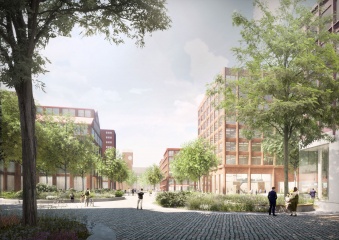
    Seelze Süd is characterized by strong references to open and clearly defined urban spaces. The quarter, which has been sustainably developed on the background of the climate crisis and resource scarcity, mediates between the existing settlement structure, trimodal western traffic axis, and open landscape. One of the outstanding features: 80% of the building blocks have a direct view on fields, forests, or areas of high quality in terms of nature conservation.

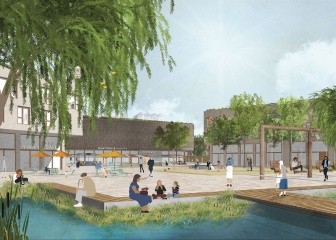
    In an exciting contrast to the wide landscape, the urban center stands as a mediating element to the existing settlement structure and as an entrance to the quarter. In direct contact with the water, there is a quarter square, retail, a health and a daycare center, a playground, co-working spaces, and student and assisted living.

    Development
    A settlement structure that is closely interlinked with the landscape is central to the new quarter. The building structure is consistently aligned with the open landscape and thus pulls it deep into the inside. In order to conserve the valuable resource soil, the areas to be built on are kept small and provided with a relatively high density. Economic development is thus guaranteed. If the roof surfaces are not used as terraces or gardens, they are used to generate energy and are intensely greened to promote biodiversity, microclimate, and rainwater retention.

    Free spaces
    Three large landscape pockets are programmed in a variety of ways: from an idyllic butterfly meadow to a small lake with a sandy beach to a BMX track, there is nothing left to be desired. At the entrance, there is also the important quarter square as a meeting point.

    Noise protection
    In order to provide protection from the 65 dB (A) expected in the north-eastern area at night, a largely closed development is used in the north and east. The chosen U-shape enables the creation of well-protected inner courtyards, which are intended for outdoor living areas. In addition, the general arrangement of the buildings enables additional noise shielding.
    Idea
  • Future quarters at Ostpark, Paderborn

    Liveliness makes the city!

    In Paderborn, with the vacancy of the Barker barracks, there is a unique opportunity to create a piece of city that shows solutions to current challenges.

    The green heart, a new open space for Paderborn, forms the central element of the urban planning concept. It complements the local recreation and leisure activities for the entire city, creates points of attraction and brings the residents together. It is also of particular importance for ecological functions such as decentralized, plant-based rainwater management. A total of 18 hectares of green space support the city's biodiversity and climate resilience.

    Strong edges with urban density frame the green centre. They develop the surrounding peripheral areas of the city structurally and functionally. The existing buildings will be converted and integrated into the edges. In doing so, they enrich the neighbourhoods structurally and programmatically.

    A total of three new quarters offer spaces for living, working, meeting and leisure. They complement the neighbouring districts with future-oriented forms of living, learning locations and workplaces. An innovative and resilient energy and heating system make the new quarters climate-positive.

    Mobility is organized sustainably and with as few cars as possible. Therefore, it is connected to today, oriented towards the future, robust and adaptable. The concept serves as a model for future developments in Paderborn. The traffic areas are designed primarily for bicycle and pedestrian traffic; rounded off by a dense public transport network. District garages on the edge of the area guarantee accessibility by car as well, but will gradually become less important in the course of the mobility transition and are accordingly designed to be reusable or easy to dismantle.

    completed
    2021
  • Düsseldorf VIERZIG549, Düsseldorf

    The colourful life!

    In the middle of the Vierzig549 quarter, the "heart" of the entire area is being created, a lively meeting place with a high quality of stay and programmatic diversity; the pacesetter for "The colourful life". The different building types „high-rise" (wooden hybrid), „courtyard house", and point house are designed as a coherent ensemble. The mix of commercial and residential uses promotes the urban character of the area. In particular, the programming of the ground floors, which ranges from commercial to Live+Work to mezzanine living, contributes to this. However, with the exception of the ground floors, the buildings are used for either residential or commercial purposes to allow clear and easy circulation.

    The green "urban grove" with park character and the multifunctional "square" complete the building structure. With their different atmospheres, they create a spatial and qualitative diversity in the quarter. Rainwater management is based on natural circulatory systems. Intensive green roofs (and extensive under the PV systems) delay runoff and encourage evaporation. An improvement in the local microclimate is expected through the systematic use and infiltration of rainwater in the open space. The inner area is car-free.

    The design of the building is guided by the image of urban architecture with echoes of the history of the area. The façade grid is robust and reminiscent of industrial building types. It is used as a base layer for all buildings and thus combines the different types of high-rise building, courtyard building, and point building as an ensemble. At the same time, the grid allows flexible filling depending on use and orientation as well as individualization for recognition value. The structural concept consistently relies on recyclable building materials and sustainable construction with wood.

    in progress
  • New Kiellinie, Kiel

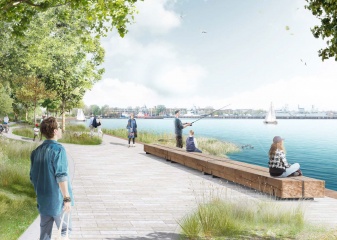
    The Kielline connects the southern center of Kiel along the Förde with the northern district of Wik. It stages the impressive scenery of the Kieler Förde and is - especially during Kiel Week - a hotspot for events and tourism.

    The Kiellinie is an important place of Kiel's identity as a city by the sea. In order to strengthen this identity, the new Kiellinie represents a connecting open space on all scales for Kiel. It combines city, landscape and water to form an ecosystem. The result increases the well-being of Kiel's people as well as the biodiversity of the flora and fauna of the Förde coast.

    The Kiellinie is divided into three sections with different atmosphere, use and design. In the north, the „Förderküstenbiotop" renaturalizes the shore edge and offers local recreation areas for residents from the neighborhoods. The middle section stages a panoramic view of the water and the opposite neighborhoods. The pulsating mile represents the tourist center and lively heart of the Kiellinie. The different sections are held together by common design elements and form the identity of the Kiellinie. The defining element is the new stone of the shore edge, which continuously stages the topographical edge between water and land. The Kiellinie adapts to the different spatial and programmatic requirements and yet forms a recognizable identity in Kiel's urban space.

    completed
    2022
  • Schönefeld Nord, Schönefeld

    How can a missing piece in the urban puzzle holistically bring together airport, landscape and existing neighborhoods?

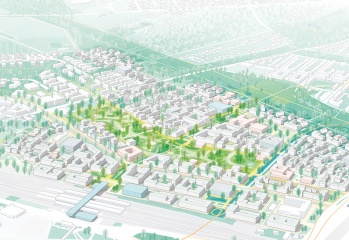
    At the border between the capital, the airport and the countryside, Schönefeld's „quarters of landscapes" combines the qualities of a major city with those of the surrounding countryside.The new urban component strengthens the qualities of Schönefeld and qualifies the existing landscape spaces. In the process, a rich urban ecosystem with great biological diversity is created.

    The northern landscape is strengthened and open space qualities are recognized for new residential locations. The starting point is the northern landscape band consisting of the Brandenburg field landscape in the west, the former Wall strip, the Rudow South Park and the Rudow-Altglienicke Landscape Park in the east. A mixed neighborhood forms the southern edge. Here, in the immediate vicinity of the train station, a compact, urban neighborhood with a strong mix of uses is being created.

    Diverse new urban quarters are located in the heart of characteristic open spaces. They create living space for a total of 11,500 new residents of Schoenefeld and 4,000 jobs in the immediate surround-ings of the train station and airport. They are characterized by their direct access to nature, short dis-tances and vibrant urban centers. A wide typological variety and a broad spectrum of public, neighborhood and private open spaces create the foundation for a variety of different forms of housing and lifestyles.

    Idea
    2022
  • Kronsberg South A.2, Hannover

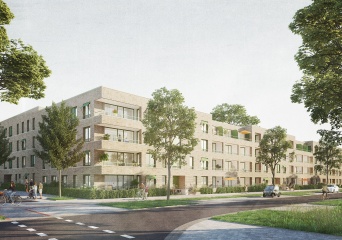
    The city block is structured by two cuts towards the public street. In this way, a community courtyard with neighboring pathways is created. The perimeter block development consists of six residential units and twelve townhouses on the east side. The street-facing brick facades are representative and respond to the importance of the entrance to the quarter. The spacious inner courtyard is zoned into a communal green center, surrounding paths and the private gardens lining the first floor apartments. All building entrances are barrier-free and all apartments are planned to be barrier-free. Each apartment has an outdoor sitting area and a small storage room. The underground parking garage is located in an L-shape under the northern block and is accessible from all staircases of the apartment buildings. There are also 145 bicycle parking spaces, some of which are equipped with charging stations.

    Idea
    2020