ul class="overview_list " id="projectList">
  • Köstra Reuse, Stuttgart

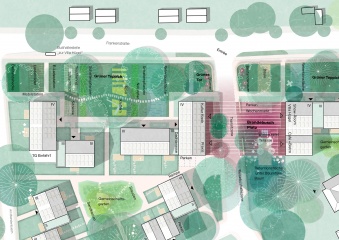
    The proposal for the revitalization of Königstrasse 1ab is based on the following 5 guiding design themes:

    Development of a building structure that completes the ensemble of the hotel and Königsstraße 1c, which incorporates heights and gradations, creates addresses and forms the prelude to Königstraße through its orientation towards the train station.

    Creation of lively, green passages with small-scale retail, gastronomy and areas for culture and events in the interior of the ensemble and a generous setback on Königstraße to provide more space for planting and passers-by.

    Enabling maximum exchange between inside and outside through diverse and generous entrances and transparent façades.

    Creating modern retail, office and restaurant layouts that can react flexibly to changing future requirements.

    Reuse of the existing load-bearing structure and individual components to minimize energy consumption and thus reduce CO2 emissions.

    Idea
    2023
  • Hirschberg-Quarter, Biberach

    Sufficient, community based, green.

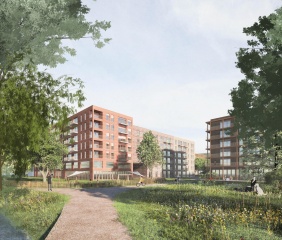
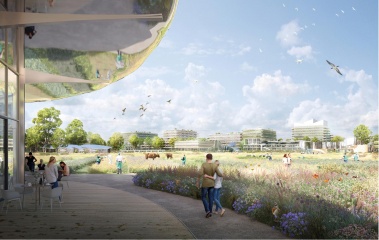
    The former site of the district clinic in Biberach is an urban area in a central location in the town and offers a rare opportunity to create an exemplary and forward-looking residential quarter. The site is characterized by its hillside location and impressive tree population, which presents special challenges and opportunities for sustainable development.
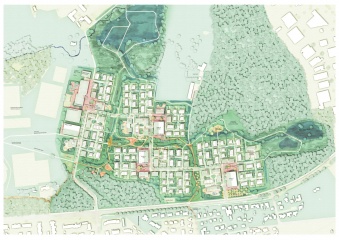
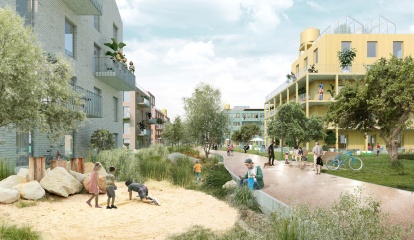
    The aim of our design is to create a diverse residential quarter that offers a home to many residents. Particular emphasis is placed on affordable and diverse living as well as the creation of a car-free interior. Efficient use of the land and the promotion of a vibrant community are at the heart of the planning. Our approach deliberately disregards the requirements of the competition by avoiding the construction of detached single-family homes. Instead, so-called neighborhood islands will be created, integrating different forms of housing and comprising 40 to 60 residential units per island. These islands are embedded in a communal open space designed to promote social interaction and encourage encounters the so-called commons.
    At the center of each island is a car-free meeting place for residents, while the private gardens are oriented towards the outside. The communal open space offers play areas, meeting points and public green areas. The adjacent wooded slope remains largely natural and offers space for vegetation, orchards and wildflowers as well as a picturesque view of the surrounding area.
    This innovative residential concept is intended to provide a sustainable and social response to the housing needs of the city of Biberach by creating diverse, green and community-oriented living options in a central location.

    completed
    2022
  • High Q, Hanover

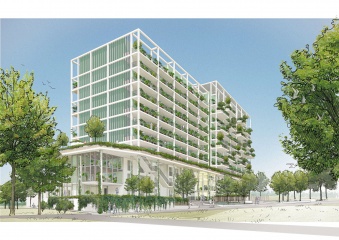
    Urban integration creates a neighborhood
    In its immediate surroundings, HIGH Q picks up on the typological and urban development characteristics of its neighborhood. The existing principles of block structures, incisions and polygonal high points are transferred to HIGH Q in order to create a harmonious overall urban image.
    On the west side of the construction site, a neighborhood square with outdoor gastronomy will be created at the interface between the office and the hotel, creating a lively meeting place for everyone. This square also serves as an entrance to the hotel lobby.

    Striking appearance creates identity
    Whether viewed from a passing train, as a pedestrian or from a bicycle, the HIGH Q always looks different and yet is unmistakable. The special façade design with 6 partial façades makes the high-rise appear slender and without a rear side, creating ever new impressions.

    Recognition value and an identity-creating design are an important requirement for this building in this exposed location. On the one hand, the façade and the striking shape create a variety of impressions depending on the viewing angle, while on the other hand the building also offers diverse and special situations in its immediate context. The undercut to Celler Strasse with its forecourt forms a clear address, the neighborhood square offers a common center for the neighborhood and the differently designed facades improve orientation and create different places.

    Idea
    2024
  • Jugendherberge For Future, Lochen

    As part of the CEWI-cooperation, Cityförster is developing an implementation concept that shows how the sustainable and careful renovation of real estate can be implemented in the DJH Landesverband Baden-Württemberg e.V.

    The mission for DJH Lochen is to be a flagship project for circularity, sustainability and sufficiency. This concept is translated to the offer of the youth hostel, and the architectural design and planning. Following the didactic focus of DJH Baden-Württemberg, the hostel should offer its guests an educational experience for sustainable awareness. This means programs with sustainability themes, active outdoor experiences, and workshops with local resources. These themes are also represented in the architectural concept. The main target groups are school groups, leisure (sports) groups, conference groups, and individual travelers like hikers, cyclists and retreat participants.

    The theme of sufficiency has guided the hostel to rethink its offer of rooms: smaller rooms to emphasize the outdoor experience, and the development of a summer house for the peak season. This summer house provides extra guest rooms in the warmer months, making a low-tech building without heating or cooling possible. The summer house transforms the old garage by extending it with a new floor on top. Upon arrival, the summer house is the eyecatcher of the circularity concept.

    The main goal of the renovation is to restructure the rooms and meet today's requirements. Because the exterior was renovated in 1982, the focus of the renovation is on the space plan and installations. This means a minimal renovation is sufficient. Where possible, building components are harvested on site or in the region, and repurposed in the summer house and the youth hostel. Where larger quantities of materials are needed, materials based on recycled resources and granulated raw materials are applied, for example recycled rubber, concrete and repurposed wood shingles.

    The beautiful location of DJH Lochen next tot the Lochenpass creates an inspiring natural environment in the forest on the hills. The existing outdoor facilities are upgraded, and new functionalities are added to extend the possibilities for outdoor activities. The new multifunctional outdoor spaces contribute to the sustainable outdoor experience of DJH Lochen.

    Idea
    2024
  • Exhibition: How to build 10.000 extra houses in Arnhem

    The Dutch government aims to address housing shortages by creating 1 million extra houses by 2030. Ministerie van Maak organized an exhibition during the International Architecture Biennale Rotterdam, showcasing solutions for housing construction, energy transition, and climate change adaptation. The exhibition featured a large Dutch model designed by 100 architects and urban planners. CITYFÖRSTER was one of the selected studios to conduct research into the development of 10,000 climate-proof homes within their 2 x 2 km area.

    Our site is located in Arnhem, close to the Central Station and including a portion of the Nederrijn. The site is characterized by a large industrial area, that is divided from a residential area by a railyard leading to Central Station. The river on the other side appears as an unused potential, as well as many undefined areas, that could use more clarity and densification.


    How to add 10.000 houses in this area? Our proposal is based on two main strategies:
    Former industrial areas are the favourite location for inner city developments. The new housing developments would be realized close to existing roads and transport and urban sprawl can be prevented. We suggest smaller scale infill into industrial areas at underused spaces such as parking areas and expansion areas and to make new connections to the river's floodplains.


    The other large potential to add quality by densification is in the low-rise neighbourhoods. Built in the 60's and 70's these areas are at the end of their first lifecycle, often inhabited by empty-nesters. We can add a couple of apartment blocks, diversifying the housing stock and the existing rowhouses could easily be topped-up with an extra layer. This creates both more housing opportunities and diverse neighbourhoods and is also an investment opportunity creating wealth on a small scale.


    Both of our strategies use the 10.000 houses not as a problem that needs to be solved, but as a great opportunity to improve our existing city.

    Idea
    2022
  • Buna Delta, Shkoder

    The Buna river delta, situated in the southeast of Shkodra, Albania, is intricately connected to Lake Shkodra via the Buna, Drin, and Kir rivers, forming a complex hydrological network. This region boasts diverse ecosystems, drawing migratory birds and nature enthusiasts. However, it faces periodic flooding, attributed to factors like heavy rainfall, snowmelt, imbalanced reservoir management, and the mountainous terrain constraining water flow.

    We propose a vision for the future of the Buna Delta, developed in close collaboration with the Municipality of Shkodra, government agencies, international donors and local experts. In this vision, flood protection infrastructure is harmoniously combined with the development of ecotourism and circular economy, as well as the improvement of sustainable mobility between the Adriatic Sea and Shkodra.

    To achieve flood resilience, a combination of natural and technical solutions is recommended. A combination of natural and technical solutions is recommended to strengthen resilience to flooding. Among these solutions is the organic development of a green river connecting the Buna and Drinasa rivers. This green river acts as a natural strip of land to divert flood water while promoting attractive vegetation. This improves water quality, creates habitats for wildlife and promotes tourism.

    To further protect against flooding, improve biodiversity, develop tourism and promote sustainable land management, measures such as the inclusion of storage areas and buffer zones along the waterfront and a resilient mixed form of agriculture are also proposed.
    By implementing these strategies, the Buna Delta can thrive as a resilient and vibrant ecosystem, providing both environmental and economic benefits for the region.

    Idea
    2023
  • Max and Moritz, Erfurt

    The primary focus of our project entails the resilient and environmentally conscious transformation of two Plattenbau buildings situated on the outskirts of Erfurt, with the objective of establishing a model that can be universally applied throughout the entire neighborhood. The volumes of the two buildings are enveloped by a prefabricated modular grid system, thereby creating an aesthetically refined and low-maintenance design. This approach facilitates not only the seamless integration of novel features, such as entrances on the north side and more expansive balconies on the south side, but also fosters the customization of living spaces and engenders a vibrant sense of community. Additionally, a continuous base serves to integrate the building into the surrounding street context, thereby reinstating a harmonious relationship with the adjacent neighborhood.

    Our material choices prioritize economic and sustainable utilization. Easily replaceable wood is employed for planter cladding and facade, complemented by natural fiber insulation and plant charcoal to offset the CO2 emissions associated with the concrete structure. Concurrently, the primary load-bearing structure is composed of concrete, ensuring both fire safety and minimal maintenance costs. A pivotal aspect of our climate-resilient transformation involves the incorporation of greenery on the facades to positively influence the microclimate in the vicinity of the building. This is coupled with a comprehensive rainwater management system, incorporating storage for utilization and retention during intense rainfall events. As a contribution to biodiversity, an assortment of plant species is judiciously combined to provide a year-round supply of flowers and sustenance for insects and birds.

    Idea
    2023
  • Life in Sandbachpark, Ratingen

    SUFFICIENT, DIVERSE, CIRCULAR

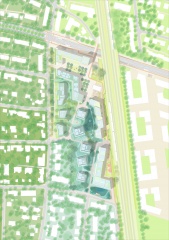
    The competition area is the first step in the restructuring of the existing commercial area into a mixed-use residential quarter. Between the cultural axis with a new metro connection in the north and the Sandbach with the future development of a park in the south, the area offers potential for a lively quarter with added value for residents, nature and the neighborhood with open spaces, buildings and services that can be used in a variety of ways. The design is based on a compact urban development that conserves the valuable resource of land and offers space for nature, rainwater management and leisure uses. The unsealed surfaces enable lush vegetation that promotes biodiversity, generates a balanced microclimate and creates atmospherically strong places. To promote the local rainwater balance, rainwater is retained on site, infiltrated, evaporated or stored in cisterns to irrigate plants. A diverse mix of uses including living, working, supply and leisure facilities creates a lively, „complete" district and reduces the need for mobility. A multimodal mobility offer organized in the neighbourhood garage consisting of sharing and e-mo-bility offers, cargo bikes, bicycle trailers, etc. reduces the space required and enables the cost-effective use of current technologies. The sufficiency district approach also reduces individual ownership in favor of shared prosperity, thereby conserving the planet's resources. Flexible (timber)system construc-tion and compact building volumes enable cost-effective construction. The sustainable building materials used, such as wood, clay, straw, etc., are used so that they can be decomposed by type. The necessary energy is generated locally as far as possible - PV on roofs and some facades, as well as geothermal energy, are used.

    Idea
    2024
  • Blue-green neighbourhoods, Münster

    The design taps into the potential to create a green, climate-adapted and carfree district for Münster Hiltrup that blends harmoniously into the existing landscape and settlement structure. Four compact neighborhoods with a large contact area to the open space will be linked by diverse green corridors in the interior (Green Delta) as well as a close-knit network of cycle paths and footpaths and attractively connected to the outside. Motorized traffic is reduced to a minimum and parking spaces are bundled. Within the neighborhoods, the mobility hubs form everyday hubs. A small-scale, differentiated development structure with ground floor uses at the neighborhood squares, social functions and various, mixed typologies suggest a people-centered scale with a rural character. In conjunction with an innovative climate adaptation concept and high ecological and energy standards, a future-oriented neighborhood development is being created for Hiltrup.

    Rainwater management follows the principle of the sponge city with the aim of minimizing intervention in the natural water balance, achieving near-natural rainfall-runoff behaviour, ensuring sufficient purification of the surface runoff that occurs, preventing flooding in the settlement area and reducing the runoff peaks into the watercourses to a natural level. Implementation is carried out as far as possible using near-natural methods with a small proportion of technical structures. In addition to the purely water management aspects, ecological benefits such as increased biodiversity and heat reduction are achieved. At the same time, blue-green structures are created that allow residents to experience the element of water.

    Idea
    2023
  • Masterplan Nové Dolíky, Slany

    How can we create a modern suburban environment suitable for pedestrians in a 15-minute neighborhood - a new district with its own urban character that can withstand the ever-increasing pace of changes in human society?

    This is achieved by creating a car-free district that emphasizes pedestrian and cycling transportation, designing compact development that forms both a clearly defined public space and an attractive living environment for future residents.
    The concept of approaching public spaces stems from the fundamental idea of relocating cars to the outer edges of the development. The majority of parking spaces are condensed into three mobility hubs on the corners of the site. The implementation of blue-green infrastructure and the provision of quality public space for the residents of Slaný form a better connection between an agricultural park in the west to the city center in the east. With all amenities within reach and accessible recreational areas, the neighborhood will ensure a healthy and sustainable living environment.

    Part of this design is the establishment of a central green axis, functioning as a retention valley and providing space for trees and biodiversity. It directs the outer landscape and waterflows into the new neighborhood and results in the
    creation of a vibrant blue and green boulevard featuring diverse private and public spaces.

    The urban structure that forms this proposal has been carefully crafted to create compact development with a diversity of typologies and financing models. It is also based on simplicity and elegance for sustainable and prospective construction methods, along with a reliable approach grounded in a connection to nature.

    Idea
    2023
  • Biotech Archipelago, Mainz

    The Bio-Tech Archipelago is a great opportunity for the city of Mainz to build on its global reputation in the biotechnology sector and at the same time develop a city for everybody. Here, optimal conditions for research and development are combined with housing, leisure facilities and a vibrant landscape for people and nature. The design focuses on favoring cooling wind currents, networking local biotopes and preserving the expansive landscape and thus fullfill the requirements of the sensitive urban location and the associated responsibility for our environment.

    Located as a gateway to the city on Saarstrasse, it communicates structurally, spatially and programmatically between the cultural landscapes of the outskirts of Mainz and the biotech axis. It is both the entrance and keystone of the westward expansion of the city and generates a variety of added urban ecological values and offers for the local environment and the city as a whole. The urban figure opens up to the open landscape in spacious corridors. The building mass is divided into four sub-areas that unite to form a flowing archipelago-like urban landscape around a common open space.

    Idea
    2023
  • Sponge City Hefei, Hefei/Anhui

    What does sustainable urban development with a special focus on the sponge city principle in China look like?

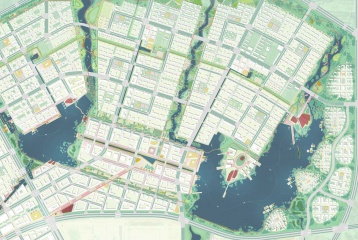
    The flagship project Sponge City Hefei relies entirely on decentralized drainage, which should lead to an answer to the flood problem and the extreme weather events that will become increasingly stronger in the future. Our focus was on the planned parks as central and profiling elements of the city, which will become the "green living room" of future residents.

    With low-threshold and barrier-free access, the offers of the residential neighbourhoods are supplemented here and the informal meeting, which is so far untypical for China, is promoted. This is achieved through the targeted use of, for example, generous seat edges, freely movable furniture, and picnic areas.

    With the aim of creating a metropolis with a low climatic footprint and a small impact on local ecosystems, four large parks with large unsealed areas are being created. The special sponge city principle provides for working with instead of against the water and implementing it as a characteristic element of Hefei. This helps the green-blue city to regulate the climate - especially in the very hot summer months. In addition to the climatic advantages mentioned, our argumentation of integrating the local river, which was originally supposed to be led around the city, creates a number of added values ​​for Hefei.

    The four emerging parks will each have their own characteristics, depending on the respective demarcation area. For example, the ground in the west with many adjoining office buildings serves primarily as a place to relax during work breaks on the one hand and as an extended conference room with options for flexible work on the other.

    The project, besides providing spatial qualities and creating urban spaces that promote
    social interaction in cultural life aims to serve as an innovative hydrological system to protect the city in the event of more extreme weather occurrences and to ensure sustainable urban development.

    As a result of all the interlocking concepts, Hefei forms a richly linked city with different biotopes and parks that work together with the social infrastructure and create a high-quality living space for the new China.

    Take a look at how we continued by planning the first park here.

    in progress
  • Sponge City Hefei - Wetland, Hefei/Anhui

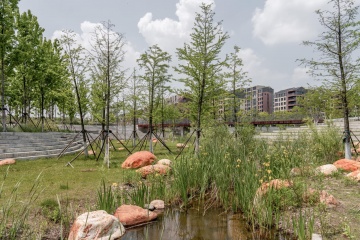
    In the Wetland Park of the sponge city of Hefei, an exciting, green-blue recreational area is being created from the necessary infrastructures for flood protection and rainwater purification.
    The low-lying wetland biotope, which develops from the depression of the neighbouring dry stream to the north, is modelled on a river delta and creates diverse ecological and scenic added value for the neighbouring urban areas. The considerable difference in height between road and water level is integrated into the design in the form of terraced slopes, which are modelled on traditional Chinese rice terraces. The different terrain levels descend towards the wetland biotope, creating a variety of recreational areas that differ in size, shape and utilisation options. The steeper areas have generous seating steps that offer residents attractive sunset spots, among other things. A variety of visual connections mediate between the city and the park landscape. The circular walkways allow flora and fauna to be experienced in the centre of the city and invite playful movement and activity.
    In its buffer function, the Wetland Park plays an important role in the city's water management: the large retention volume of the open space absorbs excessive amounts of runoff and prevents potential backwater during heavy rainfall events. The pre-cleaned water from the northern floodplain park is purified here by aquatic plants before being channelled into the neighbouring reservoir. Floating plant islands create a flowing landscape transition between the wetland and the reservoir and form a habitat for ecologically valuable microorganisms.

    completed
  • Sponge City Hefei - Floodplain park, Hefei/Anhui

    The floodplain park is one of the five green corridors in the north of the airport city and plays a key role in the overarching sponge city concept. As a blue-green infrastructure, it makes a virtue out of the threat of flooding: the technical facilities required for water management are carefully integrated into the landscape design and staged as interactive, identity-creating open space elements. The result is a valuable public green space for play, sport and recreation.
    A meandering dry stream forms a central landscape element of the floodplain park. The different water levels give it a constantly changing appearance. The neighbouring panoramic path runs close to the riverbed, along meadows and densely planted groves. Direct paths for cyclists and pedestrians connect the neighbouring residential areas. For the people who live there, the park serves as a green living room and is a meeting place for various social activities. Seating areas along the extensive retention areas invite people to linger and relax. Numerous facilities, such as a basketball court, playgrounds and a skate park, are easily accessible along the park promenade. The market hall located at the intersection with the cycle highway is a central meeting point and forms a striking spatial prelude.
    In addition to the social needs of the city dwellers, the park fulfils another important task: the surface water from the surrounding districts is channelled here and cleaned by hydrophytes in rain gardens. Collected in retention basins, the rainwater can seep away and evaporate. The dry stream diverts any excess water into the wetland. While the riverbed of the dry stream is designed for a 50-year heavy rainfall event, the green corridor as a whole can absorb the rainfall of 200-year extreme weather events.

    completed
  • Sponge City Hefei - City Terraces, Hefei/Anhui

    The city terraces give the centre of the airport city a lively and representative face to the dam. They bring the urban character and the mix of functions right down to the water's edge and create a versatile waterside edge with a promenade, shady urban trees, spacious open terraces, a bathing island, a marina for sailing and rowing boats, viewing platforms and flexible areas for events and catering.
    The shore area is divided into an elevated, flood-safe area with a pedestrian walkway and cycle path and a lower, temporarily flooded shore zone close to the normal water level of the dam, which opens up a wide range of opportunities for interaction with the water. The raised quay and promenade areas offer sweeping views along the water's edge, while the traffic-calmed riverside road creates space for markets and sporting events. Sponge city elements such as retention soil filters and rainwater overflow basins are integrated into the waterfront design as green inlays. Lush rain gardens compensate for the sealed surfaces and also enable effective buffering and natural purification of the rainwater produced.
    The northern start of the area is formed by a bathing island in front of the dam with heated swimming pools, which allow for an extended season of use. In the colder months, the island can be used as a versatile event venue. The city terraces combine urban life and water space to create an attractive and multifunctional meeting place.

    completed