ul class="overview_list " id="projectList">
  • Green Forum, Munich

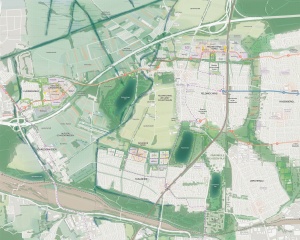
    The concept identifies three potential areas for careful urban extension: two urban neighbourhoods adjoining Feldmoching and Ludwigsfeld, and one landscape-oriented neighbourhood north of the Fasanerie. Areas of high landscape value such as Feldmoching North/West, the Obermoos and the Schrederwiesen remain undeveloped. The new neighbourhoods connect sensitively to the existing urban fabric, with open spaces acting as linking elements. A broad range of housing types strengthens social mix and creates long-term perspectives for existing residents. Local supply facilities as well as new social and educational infrastructure complement areas that are currently underserved.

    The mobility concept relieves existing neighbourhoods by prioritising public transport, cycling and walking. The "Landscape Tram" connects neighbourhoods and recreational destinations with the regional public transport network, while compact districts offer additional options such as car sharing, bike sharing and micro-mobility.

    The landscape concept builds on the productive character of the moor and heath landscape, structured by park corridors and a fine-grained network of paths. Lakes, avenues and riparian zones provide continuity and orientation. The management of rainwater and groundwater becomes a strategic component of a co-productive landscape, integrating retention areas, greywater reuse, soil-sensitive land management and rewetting strategies.

    in progress
    2024-2026
  • Industrial building Barsinghausen

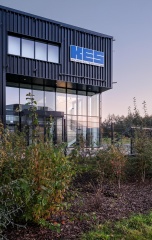
    A new company headquarters for the development and production of machine parts is being planned in Barsinghausen. The compact new building is designed to create optimal conditions for good internal communication between the work areas, thereby promoting the company's innovative strength.

    The skeleton construction allows for a combination of large open production areas and flexible office layouts. A comprehensive climate and energy concept in accordance with the KFW 55 standard provides for a geothermal heat exchanger under the building and photovoltaics in combination with a retention roof with an adjoining cistern and pond.
    As part of the social concept, the building offers the workforce a bistro area with outdoor seating and a landscaped roof garden to support informal communication and working methods and provide space for relaxation.


    completed
    2019-2024
  • Neighbourhood Island Heiterblick, Leipzig

    Large-scale networked, small-scale mixed and circularly organised - this is how we envisage the future urban expansion of the growing city of Leipzig. The landscape and urban space of Heiterblick-Süd is characterised by typologically very different settlement clusters within an open space shaped by woodland and agriculture. The design takes up this existing structure and supplements it with another compact and mixed neighbourhood embedded in a flowing and interconnected landscape - the neighbourhood island Heiterblick.


    The landscape of the Paunsdorfer Bogen is continued both to the north and south and linked with the forest and field areas to the east of the motorway. The compact neighbourhood contour folds inwards and creates green fingers that act as climate corridors and ensure effective air exchange within the neighbourhood. This creates a total of five clusters that overlap in the centre and form a bundled, central district hub with a wide variety of uses. In addition to the common centre, five green squares will create a hub and meeting points for the various neighbourhoods. These will have clear addresses and different characters. The individual neighbourhoods each have their own mix of different residential building typologies, while the centre of the district is characterised by a vertical mix of uses and public ground floor zones. The focus here is on communal and sufficient forms of living.

    completed
    2024
  • ONI Tower, Tirana

    ONI is located adjacent to Tirana's Pazari i Ri (New Bazaar), in the heart of the old town and close to Kokonozi Mosque and the iconic Skanderberg Square. Pazari i Ri, a historically significant market, recently underwent a significant transformation to include a dynamic center for shopping, dining, and cultural activities. ONI continues that transformation.

    Rather than creating a closed and isolated tower, our design's extroverted facades are open to the surrounding streets. This welcoming attitude reflects the nature of the neighborhood, which is characterized by commerce, socializing and enjoyment of urban life. By embracing and responding to this context, the plinth works to foster a sense of community and connection, promoting interaction and engagement among residents and the city.

    Above the commercial plinth rises a striking residential tower which ingeniously combines apartments and penthouses. Playful setbacks transform the facade shape, reducing the perception of mass and creating an elegant silhouette which echoes and complements its surroundings. Meanwhile the relationship between the residential spaces and their commercial neighbors adds an exciting dimension, fostering a vibrant community atmosphere and creating opportunities for social interaction and commerce.

    This forward-thinking design concept not only enhances the functionality of the building but also contributes to the overall urban fabric and residents' quality of life, enriching the surrounding neighborhood and adding a new hotspot to this lively neighborhood.

    under construction
  • Henschel Quarter, Kassel

    The Henschel Quarter opens up hertitage sites to the public and secures them through flexible use. It is integrated into the city and is accessible to everyone. The aim is to preserve the historic industrial culture and make it usable. Listed buildings are carefully restored and remain part of the public space. The industrial past will be preserved through minimally invasive interventions, while new and predominantly commercial uses will revitalize the old halls. The open space will be transformed, historical traces such as tracks and crane runways will be preserved, supplemented by green spaces and playgrounds. In terms of urban planning, small-scale building typologies create the transition to adjacent districts, while high points mark important locations. Connections for pedestrians and cyclists create a continuous and close-knit network in the district. The existing buildings will be supplemented by new buildings whose design is based on the industrial character. Historic parts of the buildings will be retained and partially integrated into the outdoor space. In the center of the quarter, a "hall for all" with restaurants, culture and sports will be created, surrounded by creative and commercial uses.

    The Henschel Quarter focuses on sustainability by preserving the existing buildings and reusing gray energy. Demolition materials are recycled on site and new buildings are constructed from sustainable materials. Renewable energies such as solar panels and geothermal energy supply the quarter, while open spaces improve the microclimate, and the combination of history, commercial, cultural and innovative offerings makes the Henschel Quarter a vibrant part of Kassel.

    completed
    2024
  • At home in Gutleut-West, Frankfurt a. M.

    What potential does Frankfurt's city centre have for conversion and sustainable inner city development? The Gutleut district in the heart of Frankfurt has so far been an infrastructurally characterised transit area and largely isolated from the nearby banks of the Main. The concept pursues the vision of transforming the area into a productive city and combining urgently needed affordable housing with urban production and new neighbourhood infrastructure. Gutleutstrasse becomes a climate strip and connects the north and south of the neighbourhood as a linear open space. Green axes connect the neighbourhood with the water. Public and residential facilities such as a school, daycare centre, local supermarket and neighbourhood meeting point ensure frequency and short distances. Institutional spaces such as the sports hall and theatre open their doors to the neighbourhood.
    The banks of the Main will be designed as a sports and recreational area and, together with the Klimastrip, will create a new blue-green neighbourhood character. In the overarching urban context, Gutleut-West will in future follow the guiding principle of a high-contrast, loosened-up and green urban landscape. Striking landmarks such as the power station and the water reservoir characterise the cityscape and mark the transition to the city centre. The central idea of 'infrastructure as a lever' illustrates the transformative potential of human-centred infrastructures. Such infrastructures go beyond their original, purely technical function and create the conditions for positive social developments. They offer the opportunity to attract interesting stakeholders from different areas and thus create synergies that radiate far beyond the built environment.

    completed
    2024
  • Change Factory, Eschweiler

    Urban development
    The Change Factory combines flexible uses and high-quality open spaces along the river Inde and Indestraße. A four-storey high building with a roof terrace marks the main entrance and lends urban presence. The three staggered building volumes form a work yard to the north and terraces to the south for working and relaxing on the Inde. To the north, the buildings are stepped down towards the cemetery. To the east is a space-efficient mobility hub, which is directly connected to the main entrance via the internal Innovation Mile.

    Open space
    The Change Factory forms an identity-forming backbone of the public space along the Inde. A spacious forecourt with dancing trees and seating invites people to linger. To the south, open terraces will be created with a view of the Inde. Trees that are compatible with the urban climate and the integration of the local water balance into natural circulation systems ensure sustainability. Green roofs, vegetation and riverbank areas delay runoff and improve the microclimate.

    Organization of use
    The building is based on a modular construction grid of 8.1m x 8.1m x 4m or 5m on the first floor. All usage units are flexibly adaptable. The Innovation Mile connects the floors via a spacious staircase and promotes interaction. Upper floors offer communication areas, the first floor presentation areas. A café at the main entrance creates an inviting entrance. Space-intensive uses and laboratories are located on the first floor, while offices on the upper floors offer units from 30m² to over 1500m² and can also be divided and combined.

    Idea
    2023
  • Exhibition: How do we want to build?

    The historic port area of the Merwevierhavens (M4H) in Rotterdam will soon begin an extensive redevelopment. Once deeply embedded in the maritime world of the Port of Rotterdam, the area is now transitioning towards new futures. Industry is moving away, and new developments will transform the area towards into a vibrant mixed-use urban district. The planning framework envisions a circular economy, smart mobility and sustainable energy concepts, among other things.

    Faced with the prospect of this change, Keilecollectief took the opportunity to ask itself "How do we want to build in the future?" This exhibition is a co-production of answers and further questions. It explores building cultures of the past, present and possible futures. The question is dissected into the themes of architecture, materials, urbanism, and landscape.

    The question, "How do we want to build?" or rather, "How do we want to build cities?", inevitably entails the bigger question of "How do we want to live in future cities?" Cityförster's contribution to the answer is twofold. Over a historical-to-speculative timeline of 1900-2050, we worked to analyze the relations between socio-economic trends, spatial policy and iconic societal developments. Through this work it becomes clear that policy is always dictating a certain quality and style of life.

    During the 20th century we observed the rise and increasing friction of our economy of growth, and how this resulted in the enormous climate impacts we are experiencing today. On the other hand, our research into four case studies reveals how urban factors such as the urban fabric, density and space ratios all impact our way of life. The study shows that high-density inner-city neighbourhoods are most cost-efficient, while also hinting that these neighbourhoods and their residents may generate lower ecological footprints.

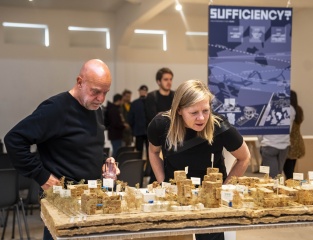
    Looking to the future, we propose spatial planning based on "sufficiency"; a rationale of urban design for a lifestyle of enough, instead of surplus. Owning less and sharing more is a key principle for community-based design, and future urban design should consider this at its core. With compact homes, biobased buildings and shared facilities, future cities should enable a sustainable lifestyle for all residents. This rationale, which reduces emissions of buildings, cities and residents, is what we call Carbon-Based Urbanism.

    The exhibition was on public display from June 15 until September 15 2024 in Keilepand, Rotterdam, and was accompanied by a supporting programme filled with guided tours, open days, presentations, debate nights, movie screenings and serious games. Through this work, Cityförster contributes to the discourse about building practices in the Netherlands. The exhibition was a co-production with Keilecollectief, Group A/CarbonLab, Happel Cornelisse Verhoeven, De Urbanisten and Studio Adams, and was supported by Stimuleringsfonds Creatieve Industrie, Gemeente Rotterdam, Programmabureau M4H, AIR Rotterdam, Cordeel, Vandersanden, and Dura Vermeer Bouw Heyma.

    Idea
    2024
  • Landesbehördenhaus, Bonn

    The site of the former state authority building is located in the framework plan area of the federal district in Bonn. In the „Laboratory" area of specialization, this formulates a diverse mixed quarter with a residential focus for the site. Following a study on the distribution of use and building mass, an urban development framework plan was drawn up in 3 urban development variants.
    This involves the preservation of two existing buildings with a gross floor area of around 45,000 m², the demolition of which had actually already been decided. Two urban residential courtyards and two high-rise buildings with a plinth level complement the existing „Liegende-8" and „L-building" to create a quarter with clearly defined urban spaces and, together with the green forum, form the robust basic structure.

    To the north, a 120m high-rise building with the Secure Digital City Campus (SDC) and additional office space in the base leads across the opening square into the center and into the quarter. Privately financed residential housing is planned above the base. The counterpart to the high-rise building is the hybrid usage module at the southern corner with a three-storey primary school and daycare base and a small residential high-rise (max. 40 m), which houses subsidized apartments for students and trainees. The schoolyard is located under the existing trees along Nahum-Goldmann-Allee, while the outdoor daycare area is located on the roof of the base level.
    One storey will be added to Liegende-8 in lightweight construction, accommodating the local supplier in the northern section and otherwise being used entirely by the city administration. The first floor areas form a generous arcade towards the green center and the 120m high-rise building. Two spacious residential courtyards (including the existing L-building) with active first floor uses towards the center (gastronomy & retail) complement the existing „Liegenden-8" to create an urban quarter.

    in progress
    2024
  • Georgia: an infrastructure gap analysis for selected sites

    This project involves a detailed public infrastructure gap analysis and the creation of an action plan for the development of two pilot sites in Georgia: Samshvilde in Kvemo Kartli and Pikalebi in Kakheti. Samshvilde is known for its archaeological and cultural heritage, while Pikalebi is historically significant as Kakheti's gateway.

    The plan aims to unlock the tourism potential of these sites, minimize environmental impact, and engage stakeholders and the local community inclusively. It includes budget estimates for the necessary public investments in both locations.

    Key project tasks encompass public infrastructure assessment, community engagement, social impact assessment, and stakeholder mapping. The report identifies development challenges and opportunities for both sites, stressing the importance of strategic planning and community involvement.

    For Samshvilde, the focus is on improving roads, drinking water, and sewage systems while preserving the village's character and enhancing public spaces. For Pikalebi, the report suggests a dispersed design approach inspired by the „Albergo Diffuso" concept to maintain the area's natural beauty and integrate hotel infrastructure with the environment.

    Overall, the action plan seeks to transform Samshvilde and Pikalebi into vibrant, sustainable tourist destinations while protecting their cultural and natural heritage for future generations.

    completed
    2024
  • Köstra Reuse, Stuttgart

    The proposal for the revitalization of Königstrasse 1ab is based on the following 5 guiding design themes:

    Development of a building structure that completes the ensemble of the hotel and Königsstraße 1c, which incorporates heights and gradations, creates addresses and forms the prelude to Königstraße through its orientation towards the train station.

    Creation of lively, green passages with small-scale retail, gastronomy and areas for culture and events in the interior of the ensemble and a generous setback on Königstraße to provide more space for planting and passers-by.

    Enabling maximum exchange between inside and outside through diverse and generous entrances and transparent façades.

    Creating modern retail, office and restaurant layouts that can react flexibly to changing future requirements.

    Reuse of the existing load-bearing structure and individual components to minimize energy consumption and thus reduce CO2 emissions.

    Idea
    2023
  • Hirschberg-Quarter, Biberach

    Sufficient, community based, green.

    The former site of the district clinic in Biberach is an urban area in a central location in the town and offers a rare opportunity to create an exemplary and forward-looking residential quarter. The site is characterized by its hillside location and impressive tree population, which presents special challenges and opportunities for sustainable development.
    The aim of our design is to create a diverse residential quarter that offers a home to many residents. Particular emphasis is placed on affordable and diverse living as well as the creation of a car-free interior. Efficient use of the land and the promotion of a vibrant community are at the heart of the planning. Our approach deliberately disregards the requirements of the competition by avoiding the construction of detached single-family homes. Instead, so-called neighborhood islands will be created, integrating different forms of housing and comprising 40 to 60 residential units per island. These islands are embedded in a communal open space designed to promote social interaction and encourage encounters the so-called commons.
    At the center of each island is a car-free meeting place for residents, while the private gardens are oriented towards the outside. The communal open space offers play areas, meeting points and public green areas. The adjacent wooded slope remains largely natural and offers space for vegetation, orchards and wildflowers as well as a picturesque view of the surrounding area.
    This innovative residential concept is intended to provide a sustainable and social response to the housing needs of the city of Biberach by creating diverse, green and community-oriented living options in a central location.

    completed
    2022
  • High Q, Hanover

    Urban integration creates a neighborhood
    In its immediate surroundings, HIGH Q picks up on the typological and urban development characteristics of its neighborhood. The existing principles of block structures, incisions and polygonal high points are transferred to HIGH Q in order to create a harmonious overall urban image.
    On the west side of the construction site, a neighborhood square with outdoor gastronomy will be created at the interface between the office and the hotel, creating a lively meeting place for everyone. This square also serves as an entrance to the hotel lobby.

    Striking appearance creates identity
    Whether viewed from a passing train, as a pedestrian or from a bicycle, the HIGH Q always looks different and yet is unmistakable. The special façade design with 6 partial façades makes the high-rise appear slender and without a rear side, creating ever new impressions.

    Recognition value and an identity-creating design are an important requirement for this building in this exposed location. On the one hand, the façade and the striking shape create a variety of impressions depending on the viewing angle, while on the other hand the building also offers diverse and special situations in its immediate context. The undercut to Celler Strasse with its forecourt forms a clear address, the neighborhood square offers a common center for the neighborhood and the differently designed facades improve orientation and create different places.

    Idea
    2024
  • Jugendherberge For Future, Lochen

    As part of the CEWI-cooperation, Cityförster is developing an implementation concept that shows how the sustainable and careful renovation of real estate can be implemented in the DJH Landesverband Baden-Württemberg e.V.

    The mission for DJH Lochen is to be a flagship project for circularity, sustainability and sufficiency. This concept is translated to the offer of the youth hostel, and the architectural design and planning. Following the didactic focus of DJH Baden-Württemberg, the hostel should offer its guests an educational experience for sustainable awareness. This means programs with sustainability themes, active outdoor experiences, and workshops with local resources. These themes are also represented in the architectural concept. The main target groups are school groups, leisure (sports) groups, conference groups, and individual travelers like hikers, cyclists and retreat participants.

    The theme of sufficiency has guided the hostel to rethink its offer of rooms: smaller rooms to emphasize the outdoor experience, and the development of a summer house for the peak season. This summer house provides extra guest rooms in the warmer months, making a low-tech building without heating or cooling possible. The summer house transforms the old garage by extending it with a new floor on top. Upon arrival, the summer house is the eyecatcher of the circularity concept.

    The main goal of the renovation is to restructure the rooms and meet today's requirements. Because the exterior was renovated in 1982, the focus of the renovation is on the space plan and installations. This means a minimal renovation is sufficient. Where possible, building components are harvested on site or in the region, and repurposed in the summer house and the youth hostel. Where larger quantities of materials are needed, materials based on recycled resources and granulated raw materials are applied, for example recycled rubber, concrete and repurposed wood shingles.

    The beautiful location of DJH Lochen next tot the Lochenpass creates an inspiring natural environment in the forest on the hills. The existing outdoor facilities are upgraded, and new functionalities are added to extend the possibilities for outdoor activities. The new multifunctional outdoor spaces contribute to the sustainable outdoor experience of DJH Lochen.

    Idea
    2024
  • Exhibition: How to build 10.000 extra houses in Arnhem

    The Dutch government aims to address housing shortages by creating 1 million extra houses by 2030. Ministerie van Maak organized an exhibition during the International Architecture Biennale Rotterdam, showcasing solutions for housing construction, energy transition, and climate change adaptation. The exhibition featured a large Dutch model designed by 100 architects and urban planners. CITYFÖRSTER was one of the selected studios to conduct research into the development of 10,000 climate-proof homes within their 2 x 2 km area.

    Our site is located in Arnhem, close to the Central Station and including a portion of the Nederrijn. The site is characterized by a large industrial area, that is divided from a residential area by a railyard leading to Central Station. The river on the other side appears as an unused potential, as well as many undefined areas, that could use more clarity and densification.


    How to add 10.000 houses in this area? Our proposal is based on two main strategies:
    Former industrial areas are the favourite location for inner city developments. The new housing developments would be realized close to existing roads and transport and urban sprawl can be prevented. We suggest smaller scale infill into industrial areas at underused spaces such as parking areas and expansion areas and to make new connections to the river's floodplains.


    The other large potential to add quality by densification is in the low-rise neighbourhoods. Built in the 60's and 70's these areas are at the end of their first lifecycle, often inhabited by empty-nesters. We can add a couple of apartment blocks, diversifying the housing stock and the existing rowhouses could easily be topped-up with an extra layer. This creates both more housing opportunities and diverse neighbourhoods and is also an investment opportunity creating wealth on a small scale.


    Both of our strategies use the 10.000 houses not as a problem that needs to be solved, but as a great opportunity to improve our existing city.

    Idea
    2022