ul class="overview_list " id="projectList">
  • Bar Center Fier, Fier

    Building on existing structures.

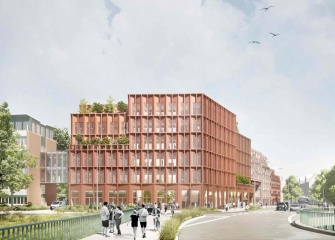
    The plot of Bar Center in Fier (Albania), located next to our projects Rinia Complex and Building Block on a central urban intersection and adjacent to an inner-city park, was occupied by an existing building from the late 1990s. This building – the plinth of an unfinished high-rise, which stood at three storeys high – was unassuming and unfitting for this prominent location; therefore, the owners approached us to extend the building and upgrade the existing floors. So we used the volume of the existing building as a starting point for the design.

    The addition activates the upper floors and makes them directly accessible from the new main square of Fier, to which the building now prominently orientates. The result is a stepped five-storey volume enclosed in a geometrical, rasterized façade. This geometrical façade, in turn, is partially clad in semi-transparent golden shading sheets, which function as a screen against the sunlight. Additionally, they bring more unity to the building's appearance. The volume, whose two newly added floors contain a publicly accessible rooftop bar with views over Fier, offers an urban topography that serves the city as a whole.

    completed
  • Aquarium Bay Hotel, Himarë

    Grounded on rich Albanian heritage.

    Aquarium Bay Hotel is designed based on the concept of sustainable tourism. The hotel comprises four separate pavilions, offering different experiences to their guests. Each pavilion has a distinct architectural language and shelters an inner courtyard with a specific and unique character. The four buildings contrast with their surroundings, as a way to accentuate and respect the outstanding local landscape. This landscape of rolling seaside hilltops covered in Mediterranean scrub, as well as the remote location, are considered two of the strongest, unique ‚assets' of the hotel.

    The approach to the hotel - by car, boat and helicopter but also by foot and bicycle – is carefully orchestrated, as it forms the start of the customers' journey. Internal circulation is organized by a series of footpaths, - a seaside path, a forest path and a main ‚barefoot' path - making for a sensory experience. The central lobby pavilion provides direct access to the spa, restaurants, conference rooms and casino. Additionally, atmospheric facilities like the plunge pool, the bonfire area, the botanical garden and the rock pool add to the guest experience. The most remote volume houses a small restaurant and bar that allows this building to be operated independent from the others, thus maximizing the privacy of its guests.


    Idea
    2019
  • Drymades Village, Drymades

    Located in Drymades beach, the holiday resort Drymades Village is composed of a series of stepped courtyards framed by architecture blending the project into a cohesive village feeling. Following the topography with a 15-meter height difference, the architecture articulates the ground levels to the stepped courtyards bringing an introverted feeling, while on the three upper floors, the units incorporate extended terraces and balconies, expanding the public life to all the levels.

    Typologically the villas are approached by the study of the predominant architecture of the location and the aim to find a different output to a resort project where individualization breaks a monotonous design. The iconic image of the Mediterranean villages will be communicated in the architecture with pre-determined elements, such as roofs and facades that compose a catalogue to personalize the villas. Mainly three differently sized units form the masterplan varying from studio units to large family units. They can also be joined horizontally and vertically, widening the possibilities for future owners.

    In total, six plazas are interlaced to each other, forming a large interior courtyard that articulates the private with the public space through openings in the architecture. Located at different heights and alternating one to the other, they open up the views of the seafront and offer a range of activities to the visitors. The main approach for the landscape is to keep as much as possible existing vegetation. The landscape changes its composition from a dense forest in the lowest part of the plot to an urban plaza in the highest part. Native species (cypress and olive trees), and plants with low maintenance (Bougainvillea, Cacti), constitute the selected vegetation.

    in progress
  • Holtenau-East, Kiel-Holtenau

    New urban coastal landscapes

    With Holtenau-East, a new urban coastal landscape is being created on a former military site on the banks of the Kiel Fjord, which interweaves previously separate settlement structures and natural habitats. Holtenau East is defined by two impressive local scenes. On the one hand the Kiel Fjord with its maritime waterfront, on the other hand, the Endmoränen forest with its distinctive topography. They not only create the stage for the new development but are protagonists by representing the climatic, ecological and cultural context. The design further develops these two elements in terms of landscape and urban development and combines their spatial and atmospheric qualities to create a new urban coastal landscape. The result is three urban landscapes with a strong character.

    Together they form a closely networked and circular district landscape developed from the site. The three quarters provide strong, site-specific answers to future living, work and leisure needs. They differ in their use of water through adapted and integrated flood and sponge city concepts that strengthen the local ecosystems. Diverse structural and open space uses close to the water ensure a high quality of living. At the same time, they improve the range of jobs, supply, cultural and leisure offers for Holtenau and the surrounding communities.

    The rainwater is collected decentrally on green roofs and retention areas and feeds a central wetland, which reduces the rainwater load on the drainage system during peaks of precipitation. The wetland saves supply costs and complements the public space with atmospheric elements. It also offers a habitat for birds and butterflies, offers potential for nature-educational offers and protects the area from flooding.

    Idea
    2021
  • Time for Lausitz

    1 room | 2 engines | 3 fields

    With the cessation of coal mining and power generation, the region of the Lausitz is deprived of one of its central economic foundations. Many employees will lose their jobs as a result of the necessary climate and structural policy decisions. At the same time, the region is confronted with the ecological consequential damage caused by years of resource depletion.

    The crisis-ridden development shows that a sustainable economic, social and ecological development in the Lausitz can no longer be based on linear systems, but that a circular economy must be built up more and more and on various levels and standards. It is time to promote material cycles, energy cycles, the hybridization of infrastructure, the networking of sectors and value chains, to establish synergies and to generate meaning.

    The key to sustainable development in the Lausitz is a careful approach that is differentiated in terms of time and space. There are a handful of clearly identifiable development drivers that can add value to the region in the short- and medium-term. They form the drivers of regional development, so to speak, and also network the Lausitz nationwide. Promoting them in a targeted manner should be the first focus of the investment.

    With the conversion of the Lausitz into a model region for organic farming, sustainable forestry and resource-conserving timber management, it can not only open up new sources of income for the primary sector but also significantly increase the attractiveness of the region as a place to live, as a location and as a holiday resort/destination. The structural funding promised for the phase-out of coal should therefore also benefit the primary sector and thus strengthen sustainable value chains.

    completed
    2021
  • Blue Eye, Sarandë

    As one of Albania's most important natural sites, the area of ​​the water spring of "Blue Eye" (Albanian: Syri i Kaltër) has been endangered by tourism for years. Our master plan is the attempt to manage "Blue Eye" sustainably and to prepare it for the expected increase in tourism. The integral strategy protects the natural monument while at the same time releasing its full socio-economic potential. This is achieved through various interwoven strategies, such as diversifying the local offering.

    The immediate area of this rare, almost unreal place is a natural monument characterized by sycamore and oak trees. With the ambitions to improve the local infrastructure for sustainable yet more intensive tourism, we developed an integral strategy for spreading the load of visitors during peak season throughout the year by providing yearly services and activities. By introducing new ways of accessing the Blue Eye Monument, we create different scenarios, points of view and vibes (hiking trails, boat trips and a family path). The program is rounded off with a visitor centre, local product shop, camping facilities and a newly developed cultural and social agenda, proposing the possibility of organizing festivals and local markets close but not right next to the Blue Eye. All of that to stimulate the unique character and potential of the area while keeping the nature intact. 

    The result is a natural phenomenon, unique on a global scale and protected for future generations.

    completed
    2020
  • Poolplatz Merzenich, Merzenich

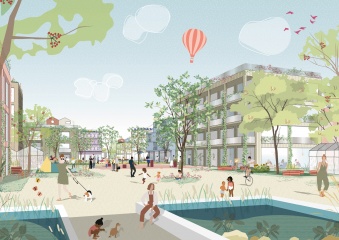
    The redesign of the pool area in Merzenich offers the chance to regain an important old square, especially the get-together, to create new structures for Merzenich. The aim is to bring back the spirit of activity, work and togetherness and the collective benefit of the square with our design. Primarily, we clean up and structure the space. Parking is pushed aside and broken up into small pieces. The centre of the square is levelled and therefore multiplying the possible uses.

    The central element is an egg-shaped water feature in front of the healthcare courtyard that feeds from a large cistern under the square. Here, excess rainwater from the surrounding buildings can be collected and stored on stormy days to create a supply for possible dry weather periods.

    The tree line traces the old building line and gives the urban layout more body. Finally, on the surrounding plots, a production, a healthcare, and a recreation courtyard are created with urban massing, providing space (structures) for a variety of uses. Housing is added everywhere to set free the pool area's full potential of becoming a busy and innovative hub where young and old can live and work together, be taught and learn, and where you can relax and celebrate.

    Idea
    2020
  • De Dorpse Flat, Nijmegen

    social, cosy, flexible
    living circularly in de Waalsprong

    For the Waalsprong quarter in Nijmegen, CITYFÖRSTER created a design for 70 social rental homes. The skyrocketing housing shortage is linked directly to the climate crisis and biodiversity loss. Seeing the potential of new social housing, we focused on high density, flexibility and low-tech design solutions to propose a circular construction.

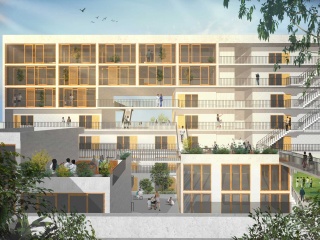
    A large main volume adjacent to a large sports hall is combined with smaller building volumes facing the park: An exciting combination with a high density of housing that still retains the community feeling of a small-scale, cosy neighbourhood.

    The various buildings, terraces, squares and apartments are connected by a network of stairs and bridges with a central lift core in the main volume, which invites you to explore, exchange and interact.

    The main volume and the smaller buildings are built from the same modular wooden elements, allowing the constructions to be disassembled and reused at the end of their lifespan. The floor plan of all apartments can be arranged flexibly. The units can be joined together so that the new development can easily adapt to changing housing demands without high costs or complicated interventions.

    Low-tech design solutions such as an awning, conservatories and solar chimneys ensure low energy consumption and reduce material use. Other installations are set up as demountable modules to round off the circularity concept.

    completed
    2020
  • Klima-Mosaik, Fehmarn

    For the neighbourhood, a robust and at the same time adaptable concept is proposed, developed from the landscape and the context. Through a variety of qualified open spaces and a communal centre, neighbourhood, density and sufficiency can be thought differently.

    Approximately 250 residential units of varying design will be created in the neighbourhood. In order to create affordable housing, the focus is on multi-storey housing. With the building types row, point, angle and double, there are four variants of multi-storey housing in the neighbourhood. The diverse housing offer is complemented by 38 terraced houses. The neighbourhood cluster in the centre lends itself to cooperative development with complementary uses.

    The natural appearance of the neighbourhood is paramount. The use of sustainable materials offers ecological and technical advantages at the same time. Apart from the design specifications for typologies and spatial edges, the variance in facade and colour design, as well as in the open space elements of the individual neighbourhood clusters, ensures individuality and orientation. Design elements from the context create a sense of belonging to the surroundings, while communal spaces offer space for self-realisation.

    The "Klima-Mosaik" is characterised by strong open space references, diverse forms of housing and an active, communal neighbourhood centre (including a meeting place, co-working, special forms of housing). In addition, the neighbourhood hub bundles mobility services and other uses (e.g. workshop, parcel station, youth meeting place).

    completed
    2022
  • WHO comes together, Tübingen

    How can you upgrade an existing district, create new living space and create a meeting place at the same time?

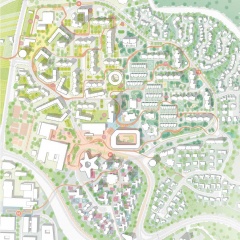
    The Tübingen district of Waldhäuser-Ost (WHO) emerged as a satellite town in the 1970s and never really became part of the city. Rather, references to urban development projects from the same period in other cities can be seen: a separation of functions or even a slight reference to the local context characterize urban planning at that time. Similar problems can still be seen today: Inadequate orientation options, unclear and poorly usable footpaths and cycle paths, few or no lively places, little usable open spaces, or even a general island character - isolated from the rest of the city. To counteract this, we have developed three key strategies that create a sustainable WHO.

    1. The barrier-free access belt
    A new hierarchical system of paths works as a connecting band with instead of against the topography. This creates a consistently barrier-free and programmatic network. Additional shortcuts ensure quick routes through the area. The band connects to central locations and stops of the local public transport and thus supports the car-free mobility offers.

    2. Three identity-forming landscapes
    Three landscapes surrounding the WHO hold special qualities. Until now, however, these have not been reflected in the structural and open space structure. Individual features from the landscapes are identified and strategically reflected in the WHO. In addition to vegetation structures and tree species, this also includes materiality and the use of open spaces that create unique places in the WHO and ensure orientation in the area. Enrich productive open spaces, offer room for communal gardening and meeting.

    3. Urban confetti creates density and liveliness
    New sources of inspiration are being strategically placed: a striking building for student accommodation defines the new entrance to the district and enlivens the new district square with a new supply center, school, swimming pool, and public transport stop. The Social-HUB in the geographical center of the district forms an anchor of the social community and spatial orientation. Like urban confetti, different open spaces and building uses are scattered over the area.

    Integrated planning
    The interaction of the three strategies creates a WHO worth living in - designed for people. The access belt leads through three landscapes, through places with different atmospheres and identities, and to different uses. No place in the WHO is like the other. A dense network of meeting places also promotes the community. The synthesis of the three strategies results in new centralities at key locations.

    completed
  • Innovation Valley Garzweiler, Jüchen

    Due to the planned coal phase-out by 2038 and thus the elimination of a complete industry with many jobs, strong visions of the future already need to be developed today. How can we reintegrate the gigantic areas that will soon be fallow again in a sustainable manner and make them usable?

    Located in the border triangle, our workshop was about developing a vision for the area in and around Garzweiler. The main goal here was to move away from the current linear to a circular economy. The starting point of the concept was the question of how we can draw a strong vision of the place that addresses its complex issues: What does innovation need? What will energy production look like in the future? How can we restore the immensely damaged ecosystem and reconnect the fragmented biotope network? And what do the municipalities and residents of the region need? How can all these aspects be thought of in a cycle and thus map a strong, sustainable system?

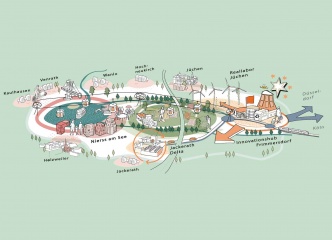
    To give answers to all of these questions, the concept provides for the creation of an innovation network from three well-developed commercial locations in Jüchen, Jackerath, and Frimmersdorf, which tie in with existing plans. The conversion of the Frimmersdorf power plant, which is otherwise to be demolished (planned paralysis in 2021), creates a supra-regional innovation hub and acts as a gateway to the region. Its huge pre-built areas serve as a playground for start-ups as well as established companies. The power plant is a visual reminder of the cultural heritage and the important past of the region, but on the other hand, shows the big step forward towards a sustainable future. The pioneering spirit that has prevailed for decades is being rethought and translated into 2035.

    Large contiguous recultivation areas for industrial agriculture feed electricity into the local grid through additional use for wind power and PV systems. We are creating ecological corridors (forestry recultivated, natural green structures), which in the future will span between the lakeshore and the forests of the Erft floodplain and, in addition to safeguarding the species network, also represent interesting areas for tourism. Thus the economic situation of the region is strengthened. They are lined with laboratory areas: small-scale fields and garden structures on which circular agriculture is researched, tested, and applied.

    Garzweiler is an attractive area, but how can villages be developed, and what offers need to be created? Resource-saving, water management, or new forms of mobility are just a selection of important topics and factors that need to be considered. We propose different lighthouse regions in which to settle. In this way, for example, the new town of Niers am See is created. With the inevitable flooding of the Garzweiler II opencast mine and the resulting lake the size of the Tegernsee, there is an extraordinary opportunity for the realization of a model city with decentralized rainwater management and close networking in the adjacent natural biotopes. As soon as the opencast mining is completed, the respective villages can grow to the edge of the former mine and then have their own waterfront promenades in the final state.

    The concept is rounded off by a cableway that links the various areas.

    in progress
    2020
  • Klimaquartier Schweinfurt - sufficient, diverse, circular, climate-positive, Schweinfurt

    What is a Klimaquartier (Climate Quarter) and how do you meet its requirements? With the Klimaquartier in Schweinfurt, we have created a possible answer that is not only about the CO2-neutral operation of the buildings, but also about the energy that has to be used to construct them and the recyclability of the materials. In addition, the focus is on minimizing as well as shifting the mobility of residents away from the car and towards environmental networks. To achieve these goals, the design for the Klimaquartier Schweinfurt follows these development principles:

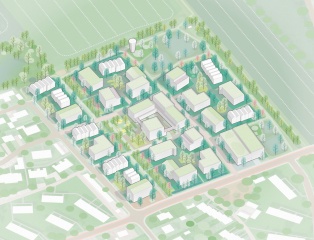
    - Compact urban planning protects the valuable resource soil and offers plenty of space for self-sufficiency, rainwater management and recreational uses.

    - The large unsealed areas enable lush vegetation, which promotes biodiversity, creates a balanced microclimate and creates atmospherically strong places. This guarantees a diverse, healthy and livable habitat for humans and animals.

    - To promote the local rainwater balance, all of the rainwater on site is seeped away, evaporated or stored in cisterns for watering plants.

    - A diverse mix of uses consisting of living, working, supply and leisure activities creates a lively, "complete" quarter and reduces the need for mobility.

    - The approach of a sufficiency quarter reduces individual possessions (living space, means of transport, consumer goods, etc.) in favour of communal prosperity, and thus conserves the resources of our planet.

    - Sustainable building materials such as wood, clay, straw etc. are used and are installed in a way that they can be broken down according to type.

    - Flexible wood system construction and compact building volumes enable cost-effective construction.

    - In addition to the existing district heating, only renewable energy sources (Photovoltaics on roofs and partially on facades) are used.

    - Made possible by a multimodal mobility offer consisting of cargo bikes, e-bikes, e-cars, bicycle trailers, etc. cars play the least possible importance in the climate quarter.
    Idea
    2021
  • New Tirana City Hall, Tirana

    Designing the New City Hall for Tirana offers a unique opportunity to shape the home of the current and future community, and to represent the values of the people of Tirana. The building should introduce a typology that reflects and outlines the features of Tirana as a diverse, inclusive, human and connected European capital. A manifesto for a City Hall 2.0, open to all. The goal is to provide a space for a genuine encounter between civil society, administrators and politicians, to encourage debates.

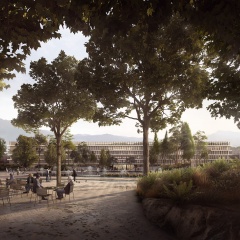
    The building comprises an efficient ring with offices that surrounds a collective atrium, which is composed of extroverted and interconnected volumes that provide space for a dynamic set of functions for both the city administration and the public. The City Hall is fronted by a civic square, a new public space which is conceived as an open-air community centre that houses many different functions for every type of use and age. Minimized energy consumption, the use of natural and efficient technologies and local renewable energy generation makes the New City Hall the first zero carbon emission building in Albania. The main structural parts of the ring office are made of locally available, sustainable wood, with the goal of becoming a carbon-neutral building even in construction.

    Idea
    2020
  • Bochum Gerthe-West, Bochum

    Three neighbourhoods for a green network.

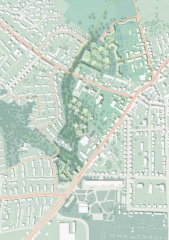
    The focus of the spatial image for the inner-city development Bochum Gerthe-West is the connection and interweaving of the existing green spaces. As a starting point for the design, they create a new ecological corridor and open space network. Furthermore, the connections between existing centralities and free spaces are strengthened and supplemented with new sources of inspiration, such as new daycare centres and mobility hubs. Strategically placed, they form bridges between the building structures and natural areas and invite you into the green.

    The design suggests a coherent and lively green sweep that can be experienced and used by residents and residents through small-scale path connections and other open space functions.

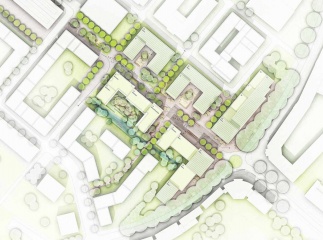
    The rich stock of shrubs and trees creates distinctive rooms and atmospheres. Building structures are specifically inserted here. This creates a compact residential area in the northern part that fits into the built urban context. The focus here is on diverse neighbourhood-related open spaces that offer room for communal uses. In the northeast, the green urban landscape is supplemented by four rows of block edge and row house typologies. They define clear settlement edges between the residential area and the landscape and still have strong visual references to the vastness of the adjacent fields. The Green Ring runs between the neighbourhoods, taking up the striking trees and networking the area for non-motorized traffic.

    New typologies are set along with the dense forest structure in the heart of the project area. In the so-called wilderness quarter, residents can experience nature. Open, small-grained and carefree play with the trees, the new buildings create an urban wilderness.

    Key figures
    Area of ​​new development: 19,302 m² (21,769 m² *)
    Gross floor area new development: 60,771m² (68,173m² *)
    Sealed areas total: 59,286 m²
    Total unsealed areas: 63,980 m²
    Approximate number of residential units: 560 (625 *)
    Number of parking spaces in district garages: 557 (668m² *)
    *including optional surfaces

    completed
    2021
  • Branch in the Landscape, Heidelberg

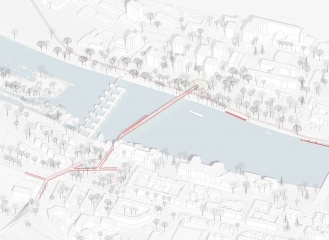
    "Branch in the Landscape" presents a holistic concept that includes both the planned cycle and footpath connection across the Neckar and its relationship with the surrounding urban landscape. The focus is on providing residents and visitors with attractive incentives to switch to environmentally-friendly mobility. Urban planning, traffic, and design aspects are being developed into a uniform green infrastructure as a catalyst for new uses of the adjacent public spaces.

    Not only the residents will benefit from the new connections, but also the future users of the cycle expressway between Mannheim and Heidelberg. The infrastructure is deliberately compact and reserved in space and the cityscape. The functional path connection is supplemented at certain points by programmatic balconies, each of which enables a view of different landscapes and thus creates several places to come together and linger.

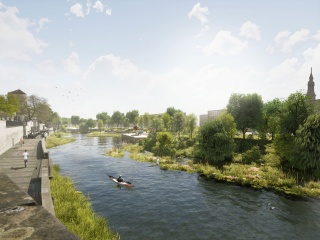
    Purposefully positioned buildings under the bridge structure (with potential uses such as a café and bicycle workshop) not only create a local path through the treetops but also create a new urban edge. Together with the bridge structure, this edge forms a new city gate in the west of Heidelberg and at the same time offers noise protection for the newly created Gneisenaupark.

    "Branch in the Landscape" creates a variety of spaces through the contrast between linear infrastructure and soft landscape, which also strengthens existing biotopes, creates new ones, strengthens the Heidelberg cityscape and helps previously separate neighbourhoods to create new synergies.

    completed
    2019