ul class="overview_list " id="projectList">
  • Sponge City Hefei - Eco Shore, Hefei/Anhui

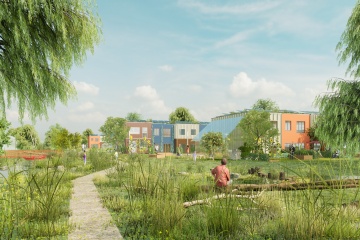
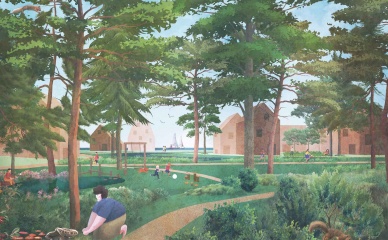
    Various near-natural areas in the southern part of Hefei Sponge City Park together form the eco shore. At a greater distance from the urban residential areas of the new city, species-rich, protected water biotopes are being created here by remodelling the bank structures of the reservoir.
    The dilapidated existing concrete embankment is being repaired and extended by a foreshore. This so-called eco-berm made of bamboo mats, gravel, sediment, wood and large stones will be placed on top of the existing structure and provide new habitats for water-loving plants and animals. The plant species introduced here improve the water quality by serving as a food source for bacteria that purify the water of the reservoir through natural processes.
    An existing woodland area is being reforested and developed into a dense urban forest, which has a positive effect on the microclimate and biodiversity. In addition, a retention soil filter hidden in the forest takes on hydrological functions. Rainwater is cleaned here and then channelled into the lake.
    The former fish ponds are being transformed into shallow water zones with bird islands and beaches. These areas, which are inaccessible to humans, provide important refuges for endangered local bird species. A panoramic platform allows people to experience the protected areas and opens up wide views across the lake. The species-rich, shallow banks create additional retention space in the event of heavy rainfall. Along the neighbouring main road to the south, a new layer of trees filters the fine dust particles.

    completed
  • Marienburger Strasse, Munich

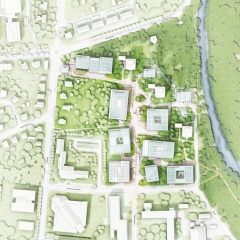
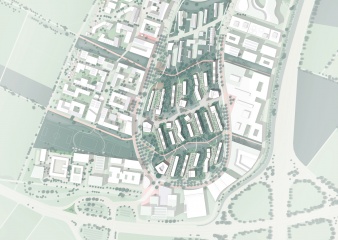
    The focus of our project is, on one hand, the careful urban integration of approximately 43,000 m2 GFA (realization part) and 10,000 m2 GFA (conceptual part) of dense housing into the existing morphological and ecological context, taking into account imposed restrictions and desires. On the other hand, the identity of our project arises from intense coordination and integration of urban planning, architecture, ecology, and landscape design.

    Characteristic of the existing urban structure of the broader surroundings of the competition area is the loose construction with small and medium-sized structures. In contrast to this morphology, the future urban fabric east of the railway track is planned as an urban densified perimeter block structure (Munich Northeast Ideas Competition). Our project establishes a context-related connection to these two different spatial conditions while simultaneously creating its own strong local identity.

    To achieve this, our design is structured into overlapping levels of order, creating differentiated and precise spatial relationships: The construction structure is divided into four typologies. In the west along Marienburger Strasse, the existing structure of rowed, rhythmically offset, small-scale buildings is appropriately complemented to ensure spatial permeability. This is followed by a loose sequence running north-south of individual building volumes (urban villas) increasing in mass and height, set in a landscape park-like arrangement. A third row consists of elongated structures on the east and north sides, which are more monolithic and taller in the northern part, gradually transitioning to a sequence of architectural individual units towards the south.

    completed
    2023
  • The Brandenbusch-Eck, Essen

    A new entrée to the Villa Hügel

    Based on the design principle "Landschaf(f)Stadt", the new Brandenbusch-Eck is a forward-looking and iden-tity-creating entrance to the Brandenbusch neighbourhood and the Villa Hügel in Essen. A neighbourhood that is being developed sustainably and serves as a centre of life for a broad range of residents. A small-scale and diverse density creates a lively place, uses resources sparingly, utilises infrastructure efficiently and relies on the mobility of the future - eco-mobility.
    Building on the strong scenic framing of the Brandenbusch neighbourhood by the Kruppwald forest and the preservation of valuable biotopes and existing trees, the "green carpet" completes the new entrance to a closed biotope network. This public green space is designed as an inviting gesture to the Hügelpark and the Villa Hügel itself.
    Brandenbusch-Platz, as a publicly effective square and protected new centre, links the new neighbourhood with the existing listed estate and promotes interaction. A new connection is created at the usage level: the social and cultural facilities in the neighbourhood are placed in a new context by the design. The connection between the church and the school is created by the Brandenbusch corner.

    Idea
    2023
  • Masterplan Wasserlagen, Herne

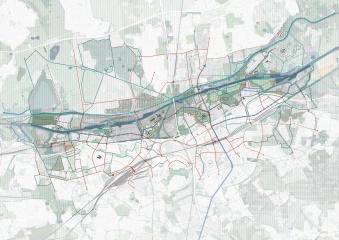
    The projected population development up to 2035 also shows the trend towards a housing shortage in Herne. Despite this development, vacancies and underused space potential characterize the waterfront area. Due to the strong commercial and industrial character of the area and the dominance of large infrastructures, the existing residential areas are exposed to high levels of noise pollution. A lack of open spaces and cultural facilities, difficult permeability for pedestrians and cyclists, as well as major weaknesses in local mobility, which is too strongly oriented towards private motorized transport, exacerbate the problem of isolated residential areas and the associated social imbalance in the area. Underused areas, vacancies and wastelands lack a coherent development perspective. Added to this are the deficient conditions in the housing offer and the external influences of the climate, energy and health crises with their very own challenges. This downward spiral must be counteracted by integrated and future-oriented planning for the entire area of the water locations. The planning objectives therefore focus on a diversified range of housing with a high degree of social diversity and programmatic mix; on the integrated development of high-quality commercial areas and the harmonization of housing, work, industry, open space, leisure and transport. A multimodal, transport connection and the structural, open-space networking of the entire area are the key factors. The planning objectives therefore focus on a diversified range of housing with a high degree of social diversity and programmatic mix; on the integrated development of high-quality commercial areas and the harmonization of housing, work, industry, open space, leisure and transport. Multimodal transport connections and the structural, open space networking of the entire area play a key role. Overarching climate goals come into focus and are linked to ongoing processes such as the coal phase-out or flood and heat protection through the Emscher conversion and sponge city principles.

    completed
    2022
  • Theoretikum Halle - Der adaptive Campus, Halle an der Saale

    Closing the gap between the university hospital in the north and the biotechnology campus in the south, the THEORETIKUM complements the science and business location in the north-west of the city of Halle an der Saale. The development site is simultaneously integrated into the urban space, functionally connected to the research and teaching facilities and integrated into the landscape. The proposed concept sees itself as a gradually growing, learning and responsive campus that integrates the existing and takes a holistic view of the new. With innovative research and technology clusters, attractive teaching and learning facilities as well as new service and communication areas, functions are bundled, synergy effects are created and potential for supra-regional impact is generated. As an adaptive campus, the THEORETIKUM is more than its individual clusters.


    The urban structure is formed by the campus loop as an address-giving backbone, a functional overlay of the clusters, building plots with adaptive development options and the integration of landscape qualities. Buildings with independent appearances (old - new, small - large, flat - high, square - rectangular) fit together playfully and, along with the uniform open space design, form a versatile, coherent overall picture. The slightly twisted structures create interesting and surprising room sequences and integrate existing elements (buildings, trees, paths) during the various expansion stages. Three existing high-rise buildings will be retained in the long term as a highly visible ensemble and will be integrated into the campus development.
    The northern entrée forms a counterpart to the UKH and is visually and functionally linked by the redesign of the junction. The pandemic center as the first building block is set back slightly and, together with the campus kiosk, conveys the leap in scale from the existing high-rise building to the loose residential development in the surrounding area. The southern entrance is designed at the mobility hub with an active ground floor. The technology and research centers will be realized as compact building blocks with inner courtyards or atriums and base floors. The active heart is formed by the service and communication center at the intersection of the urban north-south and green east-west connection.

    Idea
    2023
  • Waldstadt Jüchen, Jüchen

    From an Mining Hole to climate-positiv urban destrict

    The Jüchen South urban planning competition deals with a largely unanswered question: How do we want to deal with the post-mining landscape? And in particular: What does a settlement look like that is built on such an area? Do we leave it at the legally stipulated reclamation and pursue settlement development on a greenfield site? Or do we try to live up to the responsibility that comes with urban development and use the opportunity to make a fresh start, to make amends and to mitigate the damage done to the landscape and the global climate?

    Our contribution formulates a district as a symbol of this new beginning and an exemplary path for the future. It is based on the circular bioeconomy as an innovative economic model. Based on circular principels, the concept focuses on the sustainable value creation of local resources, especially soil, and thus creates the basis for an attractive and healthy living environment. The concept envisages laying the foundation for a new cultural landscape in Jüchen - the Jüchener Stadtwald - on the artificially created landscape area of the former open-cast mine. This forest forms the landscape architectural foundation for the settlement development, has top priority as an efficient ecosystem, is the basis of a sustainable healing process and a central element of the circular economy. It stores CO2, provides climate-positive building materials and food, produces energy, functions as a sponge forest and retention area, protects against noise, wind and dust and offers diverse leisure and local recreational functions. The urban forest in its various typologies forms the economic, urban structural and identity-creating basis of the new urban district.

    Idea
    2023
  • Könecke Areal, Bremen

    Hemelingen on the move - A new urban neighborhood Könecke-Areal

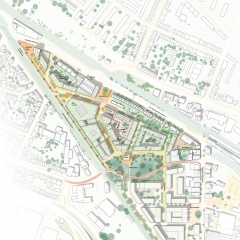
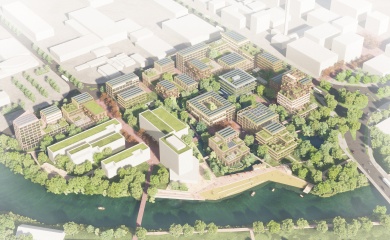
    The revitalization and reintegration of inner-city industrial areas is one of the most important planning tasks of the day. These areas are usually excellently developed in terms of infrastructure, which supports sustainable development, and can save a lot of gray energy. Complex ownership, emission sources and soil contamination are challenges that require innovative, robust and flexible urban planning concepts. The design takes advantage of the unique opportunity to free the area from its infrastructural island location in order to reconnect the districts of Hastedt, Seebaldsbrück and Hemelingen by building an urban bridge. Together with the southern (former) Coca-Cola site, which was part of a former urban design process, it forms the new center of Hemelingen.
    The vacated areas will provide what the district needs now and, in the future, - that is an affordable and diverse housing mix, adaptable spaces for working, learning, leisure and culture, but above all it is urgently needed public green space. The new neighborhood park forms the green heart of the entire district and creates a strong address to the future premium bike route that will connect the neighborhood with the center of Bremen.

    Idea
    2023
  • Climate Quarter Wolfsburg Fuhrenkamp, Wolfsburg

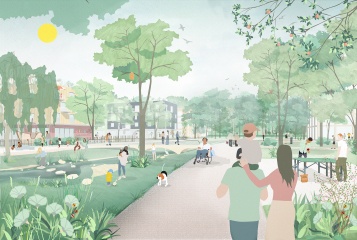
    The neighborhood at Fuhrenkamp takes on the responsibility of a climate-friendly settlement. The compact development minimizes the degree of sealing and creates generous green spaces with dense tree populations. These air-condition the neighborhood and increase biodiversity. Stormwater management functions according to a sponge city and cascade principles, in which rainwater is retained and temporarily stored, evaporates and infiltrates or is discharged into local ditches. Renewable energy is generated locally.

    The use of durable materials, building with used and recycled materials, and a wood construction method contribute to climate protection. Promoting and enabling a change in mobility behavior achieves a low-car neighborhood. The climate quarter creates a social mix by offering diverse, also new forms of housing as well as friendly street spaces for play and circulation, diverse open spaces and neighborhood centers for all generations.

    The Fuhrenkamp neighborhood is being developed in phases, beginning in the south and growing out of the city. The development in individual steps makes it possible to learn from what already exists and to make appropriate adjustments to meet changing needs. The edges of the individual neighborhoods in the area react in a differentiated manner to their context: the neighborhoods leave sufficient distance to the section of forest to the west. At the same time, the biotope network is strengthened and expanded in a vertical direction between the existing structures and the new neighborhoods to the east. The new district is holistically interconnected through a framework of neighborhood centers.

    Idea
    2022
  • Railway District, Braunschweig

    The starting point of the urban development concept is the creation of two strong open space connections that act as a green bracket, embedding the new quarter in the urban context in a variety of ways and interweaving it with this context. The green bracket links the very different and previously separate urban open spaces of Gleisharfe and Hauptfriedhof. The two open space sequences structure the hitherto unorganized urban space and give the neighborhood development a clear contour.

    The adjacent greenery flows into the neighborhood and picks up on the existing space-creating structures such as groups of trees and fallow land to interweave them with the neighborhood spaces. This creates a lively place with its own identity in a central location. The guiding ideas of BAHNSTADT are consistently developed further. In the midst of the green brackets, a compact and densely mixed urban quarter is created, which is divided into sub-segments by three axes across the green spaces. They create direct path relationships and clear orientation in the urban space.

    completed
    2022
  • MAGNUM-Areal, Osnabrück

    The Magnum site's DNA of industrial heritage and landscape succession forms the starting point for the transformation into a climate resilient neighborhood. The unique character of the former steelworks is expressed spatially in the overlapping of the scales of human, machine and nature and of the atmospheres between narrow alleys and wide squares.


    This productive interplay continues to write the history of the Magnum site in constant change. Three subspaces (water courtyards, forest campus, factory cluster) derive from the site, each with its own independent profile, which form synergies with each other and with the neighborhood. The Magnum Mile connects the three subspaces as a lively backbone of the quarter and the adjacent urban spaces to the west and east.


    For the quarter, own systems for the handling of water and soil are developed. They will be used for irrigation, gray water utilization and cooling of the quarter. The goal is to minimize erosion and soil exchange. As much accumulating water as possible is to be collected, filtered and reused. To do this, it will be stored in building-integrated cisterns. Materials collected are reused as much as possible. Existing structures, such as the grove or also hall structures are integrated and the character of the open space and the building structures are developed. The transformation is designed as a gradual, learning and appreciativ process.

    completed
    2023
  • Klimaquartier Würselen, Würselen-Broichweiden

    The Klimaquartier Würselen is characterized by strong open space references and clearly defined urban spaces. It mediates between the new and existing settlement bodies, the various neighborhoods and the open landscape in the east. In order to meet the current climatic changes and the scarcity of resources, the neighborhood will be developed in a space- and material-saving manner using timber construction; water and other resources will be used locally and treated on site.

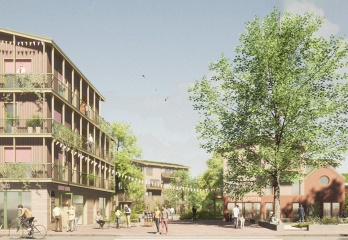
    The new neighborhood landscape complements the existing open block perimeter while forming defined neighborhoods with intimate courtyards that combine village courtyard structures with play streets. The small-scale buildings surround the Green Center, which forms the heart of the neighborhood and functions as a meeting space for the surrounding neighborhoods.

    All buildings are based on the same construction grid, which corresponds to the deep garage grid of 5m. The bulkhead construction method, optimized for timber construction, forms the basis for the feasibility of the various building typologies. At the same time, repetitive building elements and construction principles ensure efficient planning and minimized construction times. The efficient basic structure allows for a variety of floor plan types - from one-room apartments to row houses to group apartments.

    Idea
    2022
  • Ludwigsfeld München, München

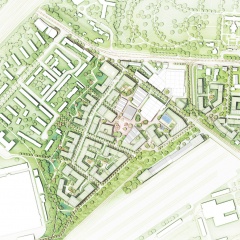
    Like a coat, the development wraps itself around the greened-out Ludwigsfeld estate. It does this conceivably loosely and discreetly over open spaces. The dissolution of grains and densities of use is small-scale in relation to the existing buildings and protects them from noise at the edges.

    The concept proposes four different urban building blocks to complement the Ludwigsfeld settlement: green residential courtyards, active neighborhood houses, a cautious addition to the existing buildings, and flexible neighborhood garages.
    Through compact and green residential courtyards with a diverse appearance, a variance in the number of stories and vertical greening, the targeted density is achieved with high residential and open space quality. In relation to the existing buildings, the residential courtyards dissolve into an open development, which also adapts in terms of the number of stories and mediates via community gardens.
    Four neighborhood houses at a central location in the neighborhood link the living with base areas for supply, social facilities and community uses. As project building sites, special forms of housing can be implemented here in alternative development models. Through a striking design and the active ground floor areas, they are crystallization points in the public space.

    The design supports the goal of a sustainable and CO2-neutral neighborhood development. The infrastructures required for the planned energy concept are integrated into the urban design and areas for energy generation are demonstrated accordingly.

    Idea
    2023
  • Köpenicker Gleislandschaften, Köpenick - Berlin

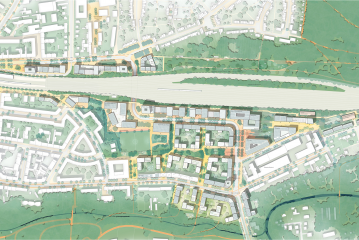
    The development of the former freight station Köpenick offers a unique opportunity to create urgently needed living space and jobs in a central, well-connected location in the immediate proximity of diverse natural landscapes. The major challenge here is dealing with the noise emitted by the railroad tracks, the industrial activity, but also the new eastern ring road.

    An open space ribbon links the area with its surroundings, takes over important climatic functions and crosses the neighborhood with public open space uses. An elementary part of the band is the undeveloped area in the north-east along the tracks, which leads the forest into the quarter and is a local recreation area and important retreat for flora and fauna. Noise protection typologies oppose the noise sources in the area and form an urban noise protection. This allows for a quiet neighborhood core with quality housing, quiet open spaces, and working environments. Uses evolve from the surroundings and respond to the differentiated context. This creates new synergies and promotes a functioning neighborhood.

    The „Köpenicker Gleislandschaften" transform the former freight station into a diverse, mixed and sustainable urban quarter, creating a strong edge at exposed locations and high-quality living in the inner neighborhood.

    Idea
    2022-ol23
  • Carbon-Based Design – Steps to Zero

    The Netherlands needs 1 million new homes before 2030. How can we ensure that they put as little pressure as possible on the environment? How can we ensure that they meet the challenging climate targets? Even if all future homes are built according to the current agreements (Nearly Energy Neutral Building BENG, and 4% emission reduction in industry), the CO2 budget for construction will run out in 2026.

    This research is a continuation of the earlier report from 2021 ' Carbon-Based Design , research into the environmental impact of residential construction'. The focus is on the embodied carbon (the material-bound emissions from the production and construction process). Which components have the greatest impact on total emissions and how can we adjust our design and development strategy accordingly?

    This report goes one step further and quantifies the untapped potential for the reduction of environmental impact in buildings. With four cases, we aim to bring emissions as low as possible, or even to zero. The report compares three strategies: reuse, renovation, and biobased construction. We do this with the MPG method, which portrays the total environmental impact of a building over its entire life cycle, which is the current Dutch legal framework. Alternatively, with the Paris Proof method by the Dutch Green Building Council (DGBC) we test these results to see if they fit within the CO2 budget. Going beyond the legal framework, we also quantify the potential of Carbon storage in these three strategies.

    completed
    2022
  • Karstadt Recycling, Berlin

    How can we transform vacant department stores in Germany and bring them to a new stage of life with new uses?

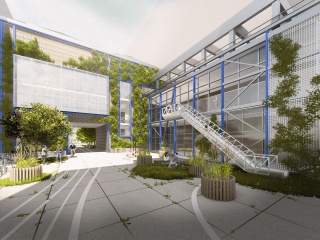
    Hundreds of department stores stand empty in German city centers. At Hermannplatz in Berlin, an old Karstadt building could be redesigned. A new façade creates a strong face in the urban context and an invitation to a differentiated courtyard sequence, which was redesigned as a playful open space experience. Instead of shopping, living, working and community-oriented offerings now meet the needs of the growing urban society in the 21st century.

    The existing Karstadt building provides valuable building materials that are deconstructed, recycled and reused. According to the layer principle, load-bearing and non-load-bearing components are structurally independent of each other. Thus, they can be used independently in their various life cycles.
    A durable, urban façade forms the new face to the city and creates a gateway to the interior.

    A varied sequence of courtyards accompanies the crossing and becomes an urban experience: the Werkhof with its lively hustle and bustle, the Green Heart as a central interface and at the same time as a place of retreat, and the city playground, which promotes interaction and participation. Flora and fauna form the connecting element of the spatial sequence within the courtyard structure up to the roof terraces.

    Idea
    2022