ul class="overview_list " id="projectList">
  • Unusual living KIDS, Bremen

    In Germany, 90% of all children live in cities - 60% in large and medium-sized cities alone.

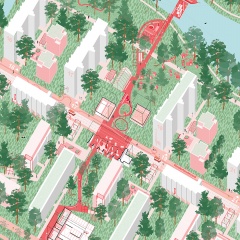
    The concept study takes this as an opportunity to redesign the existing housing estate on Bürgermeister-Reuter-Straße in Bremen Vahr according to the principles of a child-friendly city. The settlement shows various potentials in open space as well as in the building stock. In addition to the location on Lake Vahr, the rich tree population and the generous open spaces, the sealed parking spaces, the repetitive, underused open spaces, and the missing center pose challenges.

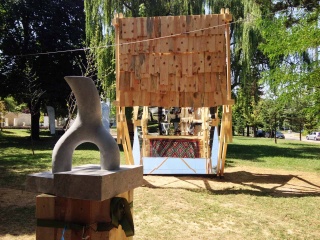
    In phase 0, a footbridge will be built that connects the neighborhoods with each other and interweaves the settlement with the network of paths in the area. It creates a center for the entire quarter, creates an address on Kurt-Schumacher-Allee, invites you to the quarter, and leads to the water. This is where people play, romp, rest, chat, celebrate, cook - a meeting point and link between the neighborhoods.

    The redensification strategy is subordinate to the maintenance of the valuable tree population and is divided into measures of upgrading, increasing, and adding. New forms of living promote the social mix in the neighborhood and enable new, diverse family structures and forms of living together in the long term.

    A central neighborhood garage on the main street, supplemented with decentralized mobile stations, enables a car-free neighborhood - this increases security, which at the same time brings more space to play on the street.

    The open space is made usable in the form of private gardens, neighborhood islands, playgrounds, and the "children's wilderness". The footbridge offers various areas of play - also for informal play and nature experiences.

    In the climate-neutral quarter, the roofs are activated as blue-green solar roofs. The rainwater is collected, stored, and evaporated. Biodiversity is promoted and made visible through bee pastures, hedges, and orchards. The footbridge leads as a research path through the future-oriented quarter. There, children can play close to nature and explore relationships between themselves and their environment. Sustainable use of resources can be learned in childhood.
    Idea
    2020
  • Düsseldorf VIERZIG549, Düsseldorf

    The colourful life!

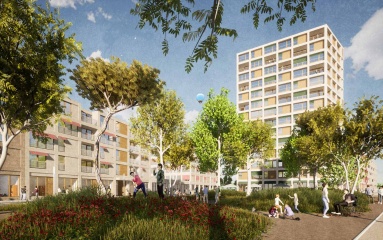
    In the middle of the Vierzig549 quarter, the "heart" of the entire area is being created, a lively meeting place with a high quality of stay and programmatic diversity; the pacesetter for "The colourful life". The different building types „high-rise" (wooden hybrid), „courtyard house", and point house are designed as a coherent ensemble. The mix of commercial and residential uses promotes the urban character of the area. In particular, the programming of the ground floors, which ranges from commercial to Live+Work to mezzanine living, contributes to this. However, with the exception of the ground floors, the buildings are used for either residential or commercial purposes to allow clear and easy circulation.

    The green "urban grove" with park character and the multifunctional "square" complete the building structure. With their different atmospheres, they create a spatial and qualitative diversity in the quarter. Rainwater management is based on natural circulatory systems. Intensive green roofs (and extensive under the PV systems) delay runoff and encourage evaporation. An improvement in the local microclimate is expected through the systematic use and infiltration of rainwater in the open space. The inner area is car-free.

    The design of the building is guided by the image of urban architecture with echoes of the history of the area. The façade grid is robust and reminiscent of industrial building types. It is used as a base layer for all buildings and thus combines the different types of high-rise building, courtyard building, and point building as an ensemble. At the same time, the grid allows flexible filling depending on use and orientation as well as individualization for recognition value. The structural concept consistently relies on recyclable building materials and sustainable construction with wood.

    in progress
  • Bergviertel Krampnitz, green I enlived I in motion, Potsdam

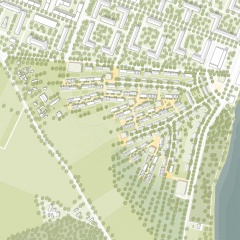
    Based on a strong landscape and valuable historical structures, Bergviertel Krampnitz is a forward-looking quarter, creating its own identity as a place to live and work in harmony with the environment. Against the background of a climate crisis and scarcity of resources, it will be sustainably developed and will serve as a centre of life for a broad cross-section of the population. A small-scale and diverse density creates a lively place, is gentle on resources, uses infrastructures efficiently and relies entirely on the mobility of the future - the environmental network.

    Small and large apartments in the same building ensure social diversity, intergenerational living connects young and old and assemblies along with community-oriented housing projects enable self-determined living. The combination of living and working responds to the trend to more strongly combine leisure and work as well as career and family. Strong and diverse open spaces, differently addressing the building plots, bind everything together and enable uses from communal gardening to sports and leisure activities up to generous landscape experiences.

    completed
    2021
  • Nivica - A model for rural development in southern Albania, , Nivica

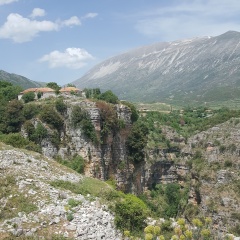
    In the beginning of May 2018 students and professionals from Albania and the Netherlands went on a trip to Nivica, exploring the village and the region, and drafting first ideas. The team included architects, urban planners, archaeologists, landscape architects and architectural historians. The workshop results built the foundation for the further development of a masterplan for Nivica.

    The goal of this masterplan is to develop a model for a sustainable and prosperous rural economy, with touristic potential within Albania but also on an international scale. As a Living Lab, Nivica allows to experiment with alternative forms of (slow) tourism, small scale investment, renewable energy and local food and waste chains. The masterplan combines the preservation of buildings and structures related to the rich history of the region with a sustainable, diverse expansion of the touristic potential.
    Nivica is meant to be the prototype for Albania's "100 villages" plan, which sets out to fundamentally rethink rural development in the country


    Idea
    2017
  • Vocational College of Machinery and Irrigation - VCMI (Vietnam), Dong Nai

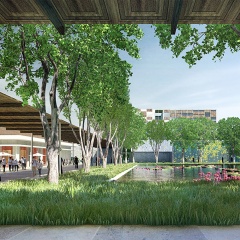
    The design of the VCMI campus is based on sustainable principles in order to handle climate and urban challenges the area is exposed to. The masterplan aims for a clear functional zoning which allows future growth. The area reserved for sports can provide a diverse offer, as an educational complement for the students, but also space, passive to be rented, so the school can reinforce economical sustainability. The proposed area dedicated to teaching and training will allow VCMI to multiply its current offer. The Campus is organized around a cooling pond which is the centre of the water treatment concept: Collected rain water can be extracted for the use of grey water in the buildings. Complementing the new expansion is also forecast a Centre of Excellence for Green TVET, an institution that is inscribed in the scope of the Vietnamese-German Financial Cooperation. The junction of these two institutions will trigger synergy effects, unlocking the campus true potential, towards the aim of establishing themselves as one of the forefront regional institutions, but also contribute needed tools, to a resilient climate change in Vietnam.

    in progress
    2015
  • SAVI Guggenheim Helsinki, Helsinki

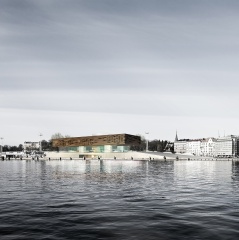
    The Guggenheim will access the richness of Nordic culture and open a door towards the East of Europe. Helsinki gets the opportunity to integrate a site with landmark potentials into the heart of the City: Reachable for pedestrians from Eteläesplanadi, adjacent to Tahititornin Vuori Park, and neighbouring Olympia Terminal, the site will be a new Connecter within the city.

    The urban design introduces a plinth to meet the challenges and foster the potentials of the site: It connects the park with the waterfront via a pedestrian bridge crossing Laivasillankatu. Pedestrians from Eteläesplanadi are directed towards the site via a stage and a grand ramp with seating – here the exhibition begins! A civic space of great quality for tourists and residents to gather and socialize. At the same time, the plinth covers the port vehicles access, ensuring undisturbed port operations. Above the Plinth and the Forum "flys" a wooden box. Its height fits into the surroundings and allows great views. The slim shape and horizontal gesture enhance the character of the site at the waterfront: a subtle yet genuine new element of Helsinki's cityscape.

    Idea
  • Perspektivplan. Spatial Vision Freiburg, Freiburg

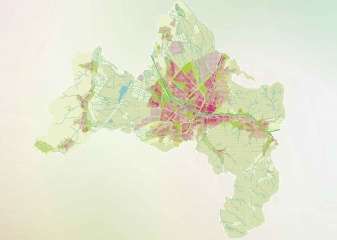
    Freiburg is a growing city where more and more people want to live. How can the city continue to be developed in a sustainable way? The Perspectivplan elaborates spatial development options for the City of Freiburg in the next 10 to 15 years. In the course of designing, built-up areas and open spaces are conceived and developed together. Based on a differentiated (GIS)-structure analysis, so far undetected potentials are made visible, development strategies are pointed out and by means of scenarios a future spatial image with a complementary structure plan is generated. The project has been developed in a cooperative process with stakeholders, the municipality, politics and the public.

    www.perspektivplan-freiburg.de

    completed
    2017
  • Greater Helsinki Vision. Eight profiles, one unity, Helsinki

    'Holistic Uniqueness' proposes a future vision and a robust
    development framework for Greater Helsinki, Finland. The
    region is globally positioned as the interface between the EU and
    Russia. A high-velocity train network links Helsinki to the Baltic
    centres, Stockholm, Tallinn and St. Petersburg, establishing a
    transnational connection.

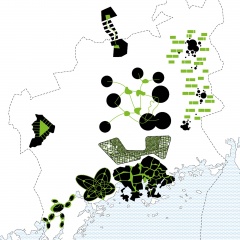
    The Greater Helsinki Region itself is defined as a configuration of eight core areas, each characterised
    by a unique programmatic and spatial profile. Based on
    the incorporation of global future developments (like energy
    shortage, demographic change etc.) and existing local potentials,
    the profiles act as concepts for sustainable development -
    ensuring global competence and creating local identity at the
    same time. A specific urban form and structure are proposed for
    each area, strengthening the programmatic profile and creating
    diverse relations between urban and green spaces. Within
    this metropolitan configuration, each area will offer something
    unique. Therefore they are linked not only by a sophisticated
    transport system but more importantly by complementation of
    each other.

    Idea
    2007
  • Green Wave. Glitnir Bank Hq, Reykjavik

    The design concept 'Green Wave' generates a holistic image and a characteristic coastal skyline for the site of Kirkjusandur in Reykjavik, Iceland. Two design principles characterize the appearance of all buildings: The dynamic shape of the wave as an aesthetic concept and the integration of green spaces as vital elements of functional and atmospheric quality. The new headquarters of Glitnir Bank, a nine-storey building addressing the prominent highway Sæbraut, will be the key figure for the future development.

    The elevated entrance plaza is secluded from the public flow on ground level and sheltered from heavy winds coming from the shore. Open working spaces can be organised and subdivided flexibly. Winter gardens on each floor increase internal lighting, provide space for informal communication and create a comfortable atmosphere and climate. A decentralized ventilation system and a heating system based on geothermal energy are implemented, which are economical in maintenance, space-saving and highly energy efficient. The façade consists of tilted glass elements creating a "deep skin" that reflects natural and artificial light in different angles.

    Idea
    2006/07
  • Urban Living. Vacant sites over the rooftops of the city, Berlin

    In accordance with building regulations, one could build at least three more full floors on top of the existing multi-storey car park Briesestraße: There is a vacant lot on top of the car park. In static terms one or two additional stories are feasible. By converting the existing floors and adding floors on top a unique building is created with a special atmosphere and spatial quality for different user groups (live and work).

    The concrete areas between the ramps are removed, which allows daylight to reach below street level. The additional units of the 2 ½ storeys are built as a light wooden panel construction. The visibility of the past leads to special appreciation. Thus, the acceptance for a good remix in the neighbourhood is far higher than for demolition and a new beginning.

    Idea
    2013-2014
  • Family Villa, Hannover

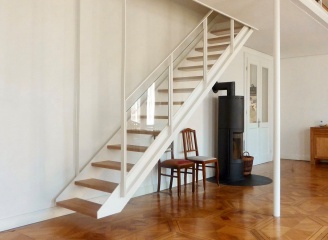
    A listed villa of the 1850ties was converted into two family apartments. The large garden is used collectively. The 1st and 2nd floors were redesigned in relation to the needs of a couple with five children. Spaces „suitable for everyday use" are created and at the same time, the special character of the historic building with its ornamental elements and valuable wooden floors is strengthened.

    To reestablish the former spaciousness a multitude of fixtures and walls were demolished. The roof was reconstructed according to current energetic standards. The first floor serves as an entrance area with a large hall leading to the kitchen and the balcony. The master bedroom and one kid's room are orientated to the garden. The former ballroom as the heart of the building is used as a dining and living room. The space has an impressive size (55m2, 6m high) and is decorated with an ornamental ceiling that was preserved and - where necessary - restored. A gallery is installed into the ballroom as a slender glass-steel-structure: The stairs are suspended from the gallery to keep the parquetry untouched. The second floor is reserved „for kids only" and features four rooms, a play hall, and a bathroom. The staircase between the two floors is enhanced in its spaciousness by opening up a part of the ceiling. All design and constructive measurements were undertaken in detailed consultation with the institution for historic preservation.

    completed
    2012