ul class="overview_list " id="projectList">
  • Primary and Comprehensive School Helios, Köln

    A new primary and comprehensive school (IUS) is planned for the former site of the Helios AG in Cologne Ehrenfeld. The school concept is based on the idea of a "university school", which spatially implements the educational objectives of inclusiveness: The school comprises the grades 1 to 13 and operates closely with the teacher training of the University of Cologne. This is architecturally reflected in an open learning environment for all grades. As part of a new high-quality and dense city block, the school should be an integral part and actor of the district: The school premises may be used publicly and the school offers a range of activities to the neighborhood.
    The school is designed as a compact structure, which is confidently positioned due to its clear-cut cubic form and at the same time contextualized by its orientation to axes and edges of the surroundings. It creates a clear address to the Vogelsanger Straße by a glass-enclosed foyer and a funnel-shaped, covered entrance situation. The inviting foyer and the localization of semi-public functions on the ground floor – such as the auditorium and educational center, the canteen, workshop and studio spaces – creates the desired integration of the school into the district and allows for important synergies of different usages.
    The common center - "the heart of the school" - spans over two floors and offers spacious stairs for meeting and seating: A great place for communication and leisure for all functional areas of the whole school.

    Excerpt from the jury report: "The jury praised in particular the optimal implementation of the educational objectives, which corresponds in a particular way to the intentions of the users. The learning environments are well designed and can be effectively used. Primary education is accessible as a separate unit on the first floor over short distances. The secondary education units I and II are localized on one level and are equipped with a spacious central communication zone, which provides space for a diverse range of activities. ..."

    Idea
    2015
  • Perspektivplan. Spatial Vision Freiburg, Freiburg

    Freiburg is a growing city where more and more people want to live. How can the city continue to be developed in a sustainable way? The Perspectivplan elaborates spatial development options for the City of Freiburg in the next 10 to 15 years. In the course of designing, built-up areas and open spaces are conceived and developed together. Based on a differentiated (GIS)-structure analysis, so far undetected potentials are made visible, development strategies are pointed out and by means of scenarios a future spatial image with a complementary structure plan is generated. The project has been developed in a cooperative process with stakeholders, the municipality, politics and the public.

    www.perspektivplan-freiburg.de

    completed
    2017
  • The Rubber House, Almere

    The Rubber House as a price winning project in the Eenvoud/ Simplicity competition was selected to be built in Almere, Netherlands, as one of 12 experimental housing projects. In volume and style inspired by the simple and archetypal Dutch barn architecture the Rubberhouse forms a simple asymmetric double pitched roof inhabiting 2 storeys, in combination with a single pitch roof with one storey. The resource saving construction consists of massive wood panels from cross-laminated timber. The outer walls and the roof surface are clad with black EPDM foil. In contrast to that the atmosphere of the inside is characterized by the natural warm surface of the massive wooden walls. The utilization concept proposes small private rooms in favour of a generous open plan living area. Clear lines of sight through the entire building support the robust, open space sequence and allow visual connections into the adjacent forest. The living room can be expanded via the large sliding glass doors onto the terrace. The high degree of prefabrication allowed for a building period of only three months.

    completed
    2011
  • Perspectives Gütersloh, Gütersloh

    Over the past decade, many gaps in building blocks have been closed in the city of Gütersloh. Various areas have been upgraded or restructured. With the integrated action plan, not only the urban design of the city will be further sharpened. With the participation of diverse actors, new prospects for the long-term development of the city are presented.

    Strategic decisions are prepared to make the city centre adaptable for changing spatial requirements in the future. The integrated action plan defines key objectives for development. Conceptual and design requirements are defined for e.g. functional mix, open space planning, or traffic issues. These recommendations are implemented and spatially located in a strategic master plan. On this basis, future developments and project proposals can be tested and evaluated and individual measures can be derived.

    completed
    2013
  • ANA Residences, Tirana

    The residential complex AnA is situated close to the Student Village of Tirana University on a magnificent hillside. The oddly-shaped site starts with a narrow edge along the street and widens sloping down 15 meters of level difference. The building folds as a continuous figure, respecting all the necessary distances to the property line and on itself. This stepped form creates a local landmark with an identifiable skyline in a very heterogeneous context.

    The site opens itself to allow a pedestrian connection between the student village and the northern areas. This passage enlivens the commercial ground floor and the compound piazettas. The cuts in building volume are a response to the urban regulations and a way to break down the overall massing into pieces more related to the human scale. The same 'cut' approach is used in order to provide light and natural ventilation for circulation spaces. The attic floor has setbacks in strategic locations of the building for best views from the terraces for the exquisite apartments. The materialization aims for an elegant appearance with differentiated materials and patterns but an overall clean white look: the plinth is of fair-faced concrete with a diamond-shaped relief, the body from white plaster, crowned by an attic floor clad in beveled tiles for a shimmering reflection of the strong Albanian sun.

    completed
    2013
  • Martin-Luther-Schule, Rimbach im Odenwald

    The Martin Luther School is an upper secondary school with a special focus on musical education. It houses about 1600 pupils. The extension of the existing building became necessary to adapt to contemporary didactic concepts and to allow for all-day care. It contains classrooms, a natural science block, music rooms, a canteen and a gymnasium.

    The design translates the demands concerning resource efficiency and preservation in a sensual and sensible manner. The main climatic feature of the building is the shape of the building itself: So-called solar chimneys foster natural ventilation by stack effect and become a significant formal element. The expressive roofscape also em­phasizes places inside the building – large roof lights extend the space upwards and provide particular light. During school hours these areas are open spaces to be appropriated by different age groups for independent learning. The building is conceived as a timber frame structure with a larch-wood cladding.

    Idea
    2009
  • Urbanizing the Periphery. Munich, Munich

    The study "periphery | landscape" identifies potentials and gives strategic advice for the long-term spatial development of the north-eastern periphery of Munich. The team was asked to work out a strategy for the development of an area of about 350 ha and to specify their findings for a sample size of around 150 ha.

    The approach is based on the following steps: The potentials of the area are recognized in a profound analysis and brought together in a synthesis map (A). Challenges concerning sustainable development in the periphery were discussed. They led the team to five strategies (B). These strategies provide a framework for long-term spatial development. They were developed in a close interplay with the design of a spatial vision for the North-East of Munich (C). The spatial vision shows ideas for future open spaces and new developments. The team invented a set of typologies of periphery settlement. The typologies focus on specific combinations of settlement and open space (D). A design for the sample site (E) is differentiated with stories, best-practice examples and development options in order to illustrate the everyday life of future inhabitants.

    completed
    2011
  • CLG Training Institute, Chalimbana

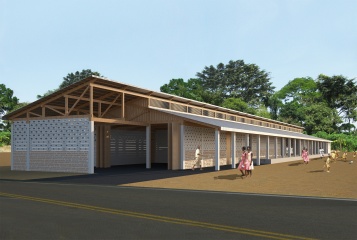
    A very special project in our portfolio is the Chalimbana Local Government (CLG) Training Institute in Chalimbana, Zambia as it can be seen as a good example of a passive and self-sufficient city. The aim of the masterplan was to increase the quality of life of both students and academic staff of the Institute, to structure the campus for the long term, and to provide the grounds with a clear, recognizable identity.

Low-tech in construction but high-tech in designing, we created a plan that included everything needed for an autarchic project. In a very sustainable manner, we used the excavated soil to press it into bricks contributing to the buildings being passively cooled and heated. To achieve that we mainly used the sun energy. From a special angle and material of the roofs to the orientation of all buildings to strictly East-West, with the main facades (North & South) avoiding the low angles of the sun, CLG Training Institute became an eco-friendly vision made into reality. Also, we made sure that the rainwater and the cleaned sewage can drain into the groundwater locally, granting a precise water cycle.

    The existing road provides access to the campus by car. Simultaneously, a new main route for pedestrian connections is established as the new 'heart' of the campus. It runs between the mostly residential area on the North and the educational program on the South side of the grounds. These two clusters - housing and education - at the two opposite ends of the campus are surrounded by the lecturers' houses, and by leisure activities. By closing off some of the student housing blocks, small neighbourhoods are created, with inner gardens and courtyards providing atmospheric living quarters.

    completed
    2021
  • Øresund Region 2040

    The project is based on three aspects: 1. future megatrends, 2. strengthening a sustainable society via social equality, healthy environment, and qualitative economic growth, 3. participation along with reflective, visionary guidance as the basis for effective and flexible developments. High-velocity train and ferry connections will enhance the position of the Øresund Region as an interface between Central, Northern and Baltic Europe.

    The development concept for the Øresund Region itself combines two main structures: the Metrosund, an association of nine cities encircling the Sund, and the Ørezones, nine sub-regional areas. Each Metrosund-City and Ørezone is given a unique profile based on existing characteristics and demands of the aforementioned megatrends, generating regional identity and global competence. Within the hinterland networks of SMESTOs (Small and MEdium sized TOwns) give a flavour of the local qualities. One key agency will guide the development process: Øresund Visionary Guidance, a multidisciplinary, independent, cross-border task force working closely with the people of the Øresund Region.

    Idea
    2007-2008
  • Park City, Tirana

    The project is located on the western outskirts of Tirana, an area which has seen major development in recent years due to its prime location close to the main entrance corridor to Albania's capital. With a total of approx. 400.000 m2 built floor area the new district will house approximately 7.000 inhabitants. It stretches between two large parks, whose conceptual design also formed part of the competition brief. Runway Park is a 1,1 km long former landing strip and Lana Park is an extension of the city's main green axis. The design proposes an urban layout that forms a hinge between these two parks, making them accessible, as well as connecting them, whilst strengthening the distinctively different character of both. The urban structure reflects a combination of three typologies: 4 storey stripes, 12 storey towers and 8 storey 'urban rocks'. The aim is to offer a broad variation of lifestyles, as opposed to the prevalent development paradigm of 9 storey broken perimeter blocks in Tirana.

    completed
    2009
  • Greater Helsinki Vision. Eight profiles, one unity, Helsinki

    'Holistic Uniqueness' proposes a future vision and a robust
    development framework for Greater Helsinki, Finland. The
    region is globally positioned as the interface between the EU and
    Russia. A high-velocity train network links Helsinki to the Baltic
    centres, Stockholm, Tallinn and St. Petersburg, establishing a
    transnational connection.

    The Greater Helsinki Region itself is defined as a configuration of eight core areas, each characterised
    by a unique programmatic and spatial profile. Based on
    the incorporation of global future developments (like energy
    shortage, demographic change etc.) and existing local potentials,
    the profiles act as concepts for sustainable development -
    ensuring global competence and creating local identity at the
    same time. A specific urban form and structure are proposed for
    each area, strengthening the programmatic profile and creating
    diverse relations between urban and green spaces. Within
    this metropolitan configuration, each area will offer something
    unique. Therefore they are linked not only by a sophisticated
    transport system but more importantly by complementation of
    each other.

    Idea
    2007
  • TXL Restart. Integral Systems, Berlin-Tegel

    The airport Berlin Tegel is going to be closed down. TXL will be developed as a high-quality research, industry and business park with the profile of 'urban technologies'. A strategic master plan builds the foundation for a flexible - and therefore, robust - planning process. Developmental guidelines and a profound system of rules create a structural, programmatic and creative quality of strategic important subareas.

    Simultaneously, more flexible developmental options are being allocated for other areas. ‚Quarters' profiles' emphasize existing potentials of subareas and strengthen the specific identity. An integrated concept for energy and water supports sustainable development: biomass, geothermal energy, wind energy and photovoltaics provide regionally generated energy. Gray and rainwater is being collected, refined and reused regionally. An urban aerial railway connects the site with the station and the tram. Here, the aerial railway is not only an efficient, sustainable means of transport but also represents sustainable mobility in terms of the site's profile.

    completed
    2012
  • House 1, Tirana

    House 1 is the first built project of the masterplan 'mirror twins'. On top of a shared commercial ground floor a green link connects the site with the close-by park. The two seperate buildings connected by the common plinth are generating an enormous amount of requested square meters. Rather massive volumes are perforated by a series of programmatic voids that connect to a common circulation space, an inner void. The much needed public space is integrated into the building by creating a second entry level and reinterpreting the circulation space. The engraving appearance
    of House 1 refers to the typical salient facades of Tirana. Multiple tilted strips create a rich play of light and shadow.

    completed
    2009
  • District Centre Mastbrook, Rendsburg

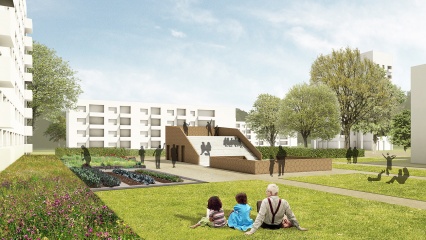
    The urban concept is based on a compact building envelope positioned on the plot, creating multifarious open public spaces for various outdoor use. The compact volume is achieved by stacking the program: The space-centred gym is located on the first floor, the community centre with its open, active and animating facades is based on ground level. Emerging from its program, the building volume is shaped with several recesses and kerfs.

    The entrances to the different functions are visualized by cut-outs of the volume. The building attains efficiency by layering functions and multiple-shift usage. The structure consists of a mix of reinforced concrete on the base and prefabricated cross-laminated timber on the upper storey. On the ground level, the facades are designed with large glazing elements and fibre-cement coated with colourful patterns. The facades of the gym are clad with black, large scale trapezoidal sheetings. Translucent façade areas from polycarbonate panels stretch around the upper corners, in order to give further differentiation to the building volume and embed it in the surrounding scale.

    Idea
    2014
  • Green Wave. Glitnir Bank Hq, Reykjavik

    The design concept 'Green Wave' generates a holistic image and a characteristic coastal skyline for the site of Kirkjusandur in Reykjavik, Iceland. Two design principles characterize the appearance of all buildings: The dynamic shape of the wave as an aesthetic concept and the integration of green spaces as vital elements of functional and atmospheric quality. The new headquarters of Glitnir Bank, a nine-storey building addressing the prominent highway Sæbraut, will be the key figure for the future development.

    The elevated entrance plaza is secluded from the public flow on ground level and sheltered from heavy winds coming from the shore. Open working spaces can be organised and subdivided flexibly. Winter gardens on each floor increase internal lighting, provide space for informal communication and create a comfortable atmosphere and climate. A decentralized ventilation system and a heating system based on geothermal energy are implemented, which are economical in maintenance, space-saving and highly energy efficient. The façade consists of tilted glass elements creating a "deep skin" that reflects natural and artificial light in different angles.

    Idea
    2006/07