ul class="overview_list " id="projectList">
  • Cross-over, Düsseldorf

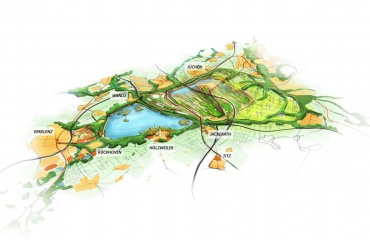
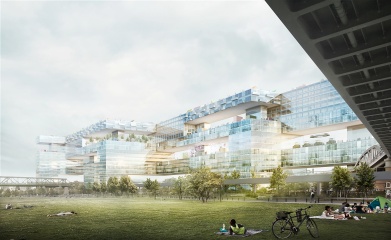
    At the junction between the media harbour area and the economical harbour area, a vibrant district is created, which has the interlacement of space, atmosphere and program as its principle. An encounter place for working, researching, inventing and recovering with a strong connection to the water arises. Two differentiated loops form the basic open-space framework. Central is the entirely experienceable loop of the leisure harbour with the urban city beach, green terraces, rowing club, marina and the "Kesselplatz" - square at the top of the peninsula.

    Future-oriented is also the industrial harbour, which fits like a second cycle in the system, as the industrial world 4.0 changes. Both "ports" get their new head-end structure through the Pier-One. The loops are connected via 6 public spaces, so-called braces, which pave the way for three squares - Kesselplatz, Hafenplatz and city beach - creating customized meeting places for visitors and residents equally. The urban structure is also characterised by the intermeshing of typologies and promotes innovation, creative work and vibrancy. This "striking harbour mixture" with towers, halls and bars forms the identity-creating and highly flexible structure for a vivid and multifunctional quarter.

    Idea
    2019
  • Space.Perspective.Würzburg., Würzburg

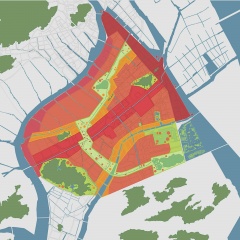
    The „Space.Perspective.Würzburg." forms the basis for the redesign of the land use plan. The focus is on the concrete space, because only here can competing spatial demands be examined, weighed up and prioritised. Based on a variety of specialist analyses, site explorations and multi-faceted participation formats, a planning instrument case is created from the spatial image, area typology, spatial references, development focuses and synthetic future perspectives. All in all, this results in a strategic spatial image for the entire city, which on the one hand forms a strong framework and on the other hand can react flexibly to changing framework conditions. From this spatial information, very concrete strategic development goals can be derived for the land-use plan, which have already reconciled competition for space and contradictory requirements.

    completed
    2019
  • Facade renewal high-rise building of the Leibniz University Hanover, Hannover

    The Leibniz University Hannover (LUH) is planning to renovate the facade of the high-rise building at Appelstraße 9A. With a height of almost 70m, the high-rise is a landmark in Hanover's urban space. Comparable to the main building Welfenschloss and the Conti high-rise, it is one of the main addresses of the LUH. Both buildings are characterised by a high degree of plasticity and a warm, sandy-golden colour. The facade design for the Appelstraße high-rise building takes up these characteristics and formulates an independent, future-oriented design on this basis. By layering the building components, the new façade of the high-rise building experiences a high degree of plasticity and depth. All components receive a warm, sandy-golden materiality - from the aluminium pilaster strips and cornices to the matt glass of the balustrades to the pixelated PV modules and the sun protection. A surrounding wooden bench in the interior and exterior space offers an area for informal learning, dialogue, waiting, resting and enlivens the entire ground floor zone. The "media storey", which extends beyond the attic, radiates messages such as the typical binary code of Leibniz, visible from afar as a light installation.

    Idea
    2019
  • TreeTop Trail Lagodekhi, Lagodechi

    Lagodekhi Protected Areas (LPA) in the extreme north-eastern part of Georgia at the southern slopes of the Caucasus and with altitudes from 590 to 3500 m, is one of the world's best-preserved areas with diversity of natural landscapes. The project of developing a TreeTop Trail as a new touristic product is to attract more visitors and, considering the transboundary potential of the LPA, make it one of the most attractive destinations, to be included in future transboundary ecotourism products.

    The concept emphasizes the forest as the protagonist and proposes a minimalistic design, a circular shaped trail that gradually ascends towads the tree canopies. Additional program is added in order to enhance the experience of forest. This includes a watch tower, a dome, a large net, a cave, and multiple platforms.

    in progress
    building permission 2019
  • New Axis Monheim, Monheim

    The city of Monheim am Rhein looked for concepts for the transformation of the shopping center Monheimer Tor and its surroundings, which connect the city center of Monheim with the neighboring district "Berliner Viertel" to the south.

    The main principle of the design is a new urban axis that connects the two unequal halves of Monheim and adds new urban spaces in the form of two squares with different characters. The area is densified with mixed city blocks, in which flexibly usable plinths are combined with residential and office space. The mall is partially corrected and rebuilt on the south side, creating new entrances and passageways and giving the south side of the building an attractive new face.

    The design underlines Monheim's urban ambitions. The threat of further land consumption and the growing need for mobility connected to it is opposed by a concept that aims at inner-city densification, intensification, and flexible mixed uses.

    Idea
    2018
  • Water town Limmer, Hannover

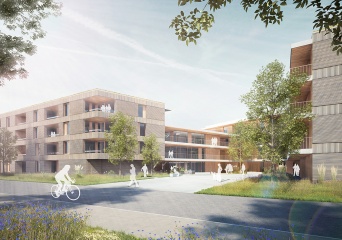
    The program of the new quarter entrance describes a modern mixed-used block in which different functions come together and are arranged compactly to each other. The entrances to the main functions are oriented towards the public spaces and emphasise the priority square and corner situations in the urban context. The 7-storey residential tower houses 60 micro apartments with a café on the ground floor along the entire facade. The eastern block houses is the assisted living, the western block is the care facility, including the supermarket with parking decks and a southern and northern row of shops. All ground floor facades with public uses open up to the public space with generously sized windows. The design envisages a solid construction method in reinforced concrete and brickwork, which optimally depicts the various building parts, functions and room sizes according to their requirements.

    Idea
    2019
  • Unfold Rosenstein, Stuttgart

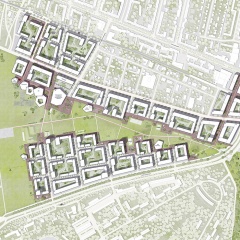
    The project completes Stuttgarts inner city. Like a mosaic, three new quarters fit into the existing situation and create an extension of the district with a strong and individual character. The three new quarters refer structurally to their surroundings and create together with their own „centres" strong identities. The common „urbangreen ribbon" connects the inner part of the city with the surrounding and creates a mutual meetingspace. By doing so the barrier of the track curve can be dismantled and transferred into a new central open space concept with an inner green lung. In the new eastern district-seam, the historical park meets mediating landscape, various leisure offers and finally the new district. A central key in the Rosenstein mosaic are the large school campuses, which act as joints between the new quarters and merge the open-space „seam" with the „urban green ribbon". In this way the project is embedded in Stuttgarts large-scale green system and is at the same time strengthening the connection to the Neckar, to Bad Cannstatt and the whole city of Stuttgart.

    Idea
    2018
  • Meyer Forum, Osnabrück

    At the Hettlicher Masch, the new heart of the Meyer&Meyer company site is to be built. The office building is designed to be open, inviting and present as a "forum". The design is naturally integrated into the height development of the surroundings, forms a striking and inviting address to the street, but is also present and visible to the highway due to its three-storey structure.

    The rooms of the office building are organised around a two-storey gallery room and offer flexible work and learning rooms as well as a large variety of programmes with a café, showroom and fitness area. The ground floor in particular is characterised by its floor plan flexibility, as the atrium can be extended for company parties or large congresses. In addition, spacious terraces and loggias form encounter zones and recreation areas. A photovoltaic system, extensive roof greening and an intelligent self-sufficiency concept make this design in wood-reinforced concrete hybrid-construction fit for the future. Thus this design is also a prototype of new working worlds, which are characterised by atmosphere, diverse meeting spaces and flexibility of use.


    Idea
    2016
  • Lively skyscraper ensemble, Berlin

    The city of Berlin is characterized by solitary peaks that build up little connection to each other. The skyscraper confetti thus forms the opposite position to the clearly defined perimeter block development. The design area, as a gateway to the densely populated area of the City West, brings the great potential of four related properties and their simultaneous development.

    A cluster of 2-3 high points will be formed on each plot, inspired by the diverse buildings in the surrounding area. The distribution of the building mass on different high points makes the buildings resilient and efficient since they can be divided and used differently. The concept is based on the continuation of the diverse and sophisticated urban structure while at the same time ensuring high land utilization. By emphasizing the intersection as an urban, high-density hotspot, a new location with special centrality and distinct urban conciseness is created.

    Idea
    2018
  • Gymnasium Lutherschule, Hannover

    The draft envisages an extension of the Lutherschule through a powerful and independent structure, which fits into the existing block structure and self-confidently positions itself to the Engelbosteler Damm.
    The five-storey building forms in a modern and contemporary architectural language a clearly perceptible address while radiating openness and transparency. At the same time, the indented ground floor facade with its striking brick arches creates a spacious and covered entrance area.


    The central organizational idea is the clustering and self-evident stacking of the different areas of use:
    The communal areas are located on the ground floor, the creative areas on the 1st floor, the natural sciences on the 2nd floor and the grade clusters on the two upper floors. As in the floors below, the classrooms are grouped around a central communication zone that creates additional learning venues with niches and open areas.


    Idea
    2018
  • Green, greener, Pelikan, Hannover

    The design sets the urban development capstone for the Pelikanviertel. The original factory premises, the Neikes buildings, the FOUR and the "green, greener PELIKAN" - each stand alone and at the same time relate to each other. The self-similarity of the five buildings creates a strong, characterful unit that responds individually to its neighbourhood.

    Each of the five L-shaped buildings consists of a two-piece "bar" and a "head", which is formed by the accentuation of the high points by means of pyramid-like roofs and represents the prelude to the quarter. The roofs allow the maximum utilization of the plots and increase the recognition value. The range of uses offers variety - from green living, or mansard apartments with roof gardens, to hybrid studio apartments, to a variety of forms of use on the ground floor, which gives the street a unique character. The green oases in the courtyards provide a retreat and are the centrepiece of the design. Intensive greening of the balconies and facades form vertical gardens and, in addition to privacy, sun and noise protection, provide high-quality open space with privacy despite relatively dense development.

    completed
    2018
  • District Landscape Dietenbach, Freiburg im Breisgau

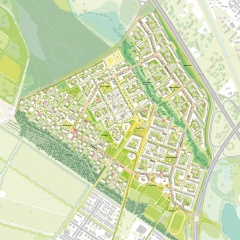
    How does a newly developed city district become a vibrant place to live?

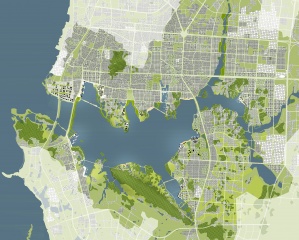
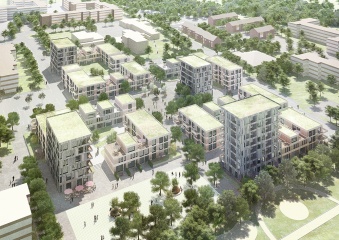
    The characterful landscape of Freiburg with the surrounding Schwarzwald serves as the decisive basis for the newly designed district Dietenbach. The four emerging quarters will be connected by a ring boulevard. In contrast to the generous open spaces, which serve as decelerated exercise and relaxation areas and make a significant contribution to nature and species protection, pulsating life takes place here. The new city centre serves as a bracing supply center and community reference point with symbolic centrality. In addition to the 5,500 residential units, new jobs and schools will be created in the 108-hectare area, which will complete the new living environment.

    Integration into the urban, functional, and landscape context
    The new district Dietenbach is structured by the iconic landscape, especially the eponymous Dietenbach.

    The resulting open spaces ensure the supply of fresh air and a stable microclimate. The former course of the Käserbach river has been reactivated and serves as partially communal garden land. In the region of ​​the school and sports campus, this zone also includes play, sports, and recreation areas that can be used by the public.

    In contrast to this, the new centre of the district as a communal supply center offers space for weekly markets, city festivals, outdoor areas for restaurants, and water features. There are also retail stores, gastronomic offers, and services. The building plots of the compact quarters address different market segments. A large number of construction site sizes, building heights, building types, and locations provides a large typology mix and thus offers a lot for different target groups.

    Mobility concept
    The mobility concept pursues the goal of reducing motor vehicle traffic, car ownership, and the number of parking spaces. This makes an important contribution to an attractive living environment, affordable living space, and environmentally friendly transport. It is achieved by creating attractive offers for pedestrian and bicycle traffic, public transport with light rail, as well as offers for car sharing and e-mobility, and also by parking in district garages in less sensitive locations that are up to 200m away from the apartments.
     

    completed
    2018
  • Open Neighbourhoods, Monheim am Rhein

    This urban design aims to create an attractive living environment for young families and couples and to give a new impulse to a large social housing estate from the 1960s. The existing open block structure will be maintained but is transformed into a structure with semi-private courtyards.

    Different typologies - i.e. houses with ground-level access, apartments with open floor plans - add variation to the housing supply. Within the building blocks, elevated courtyards create a safe environment for social interaction between inhabitants, especially young families. Notwithstanding their open character, these courtyards offer a clear visual and functional border between public and private spaces.

    Between the blocks, a sequence of car-free squares that draw on the surrounding structure contributes to a lively public space. To keep spaces as car-free as possible, most of the parking is organized in underground garages which are accessible from the edges of the block. By drawing on the existing structure, and by continuing the green belts and the existing rows of trees, the design creates a strong link with its surroundings.

    completed
    2016
  • New Neighbourhood Hilligenwöhren, Hannover

    The new residential neighbourhood Hilligenwöhren is located on the threshold of a compact city to open landscape in Bothfeld. A composition of three- to four-storey buildings generates two courtyards with different spatial qualities. The norther green courtyards are the new neighbourhood's intimate centre, whereas the southern courtyard opens up to the street and hence to the neighbourhood.

    The buildings are connected via access balconies which activate the courtyards and are the basis for a vivid community. The central community room for all residents connects the two green spaces. It is the neighbourhood's living room. By opening and widening spaces, informal meeting points and social contact surfaces are offered. The building structure enables a flexible arrangement of various residential typologies und therefore a social mixture.

    A solid structure for the development of a long-lasting neighbourhood is offered. Furthermore, natural building materials ensure comfortable and healthy living environments.

    completed
    2016
  • Student City 2, Tirana

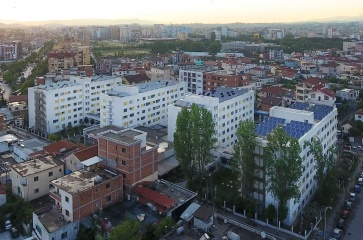
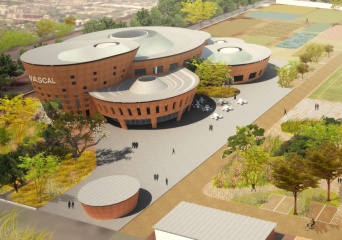
    Our reconstruction concept of Tirana's "Student City 2" aims to show the great potential for particularly thermal energy savings in construction, modern student housing and is showcasing a well performing example how public and private sector can interact. As the buildings suffers from massive deterioration on the inside, main focus of the energy concept lays on a replacement of all basic infrastructure, including a adequate ventilation and heating systems as well as new windows as its centrepiece to remedy humidity. Different subdivisions of student rooms with joined shared bathrooms and modifications in use of common rooms allows spacious privacy and reacts on students needs. Applying a complementary colored orientation and material system for each dormitory allows visual indication of buildings, floors and rooms and provides "Student City 2" with a unique identity. As the roofs of the buildings offer common space, they can be used according to public or economic visions of its users and leverage "Student City 2" to be Albania's pilot energy efficiency project.

    under construction