ul class="overview_list " id="projectList">
  • Tannenberg Quartier, Bremen

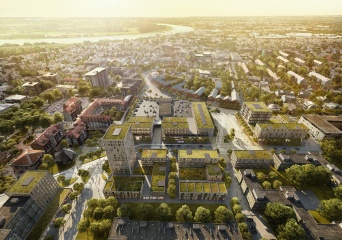
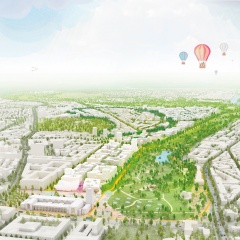
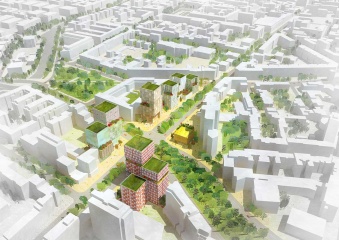
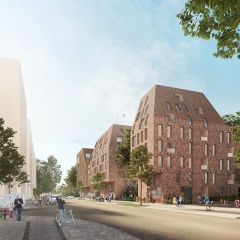
    The Tannenberg quarter is characterised by a distinct build framework that forms a clear centre and protects the quarter from traffic noise. An independent ensemble.

    The entrances and views of the quarter integrate into the existing context. The network of paths creates several links to the allotment gardens and the neighbourhood to the west: The Gumbinnenweg with its prominent row of trees becomes the main link for pedestrian and bicycle traffic. Private gardens and surrounding garden paths form connecting transitions to the private gardens of the neighbouring residential buildings and the allotment gardens (Klönschnack am Zaun).

    The generous open spaces with dense tree population ("grove") and the various garden areas have a significant influence on the character of the quarter: this is where you live "garden green".

    Idea
    2020
  • circUlar Hall - Green Ring, Mannheim

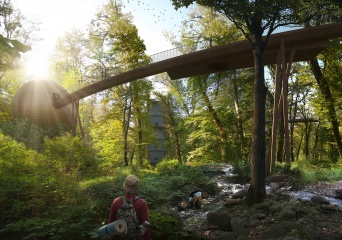
    The existing U-Hall is the heart of the BUGA. A green ring floats above it as a landmark visible from afar.
    It is a living sculpture that stands for sustainable recycling management, the willingness to experiment and a spirit of optimism.

    This circularly conceived tree hall, brought into the vertical, is not only part of the exhibition, but also a break in the tour and a place for the best views over the entire site. The tree house, built from recycled building materials, provides a habitat for flora and fauna, exhibition opportunities for field research and allows views of the solar power plant on the U-hall. Thus the ring is the central location of the U-Hall. This is where the tours and guided tours start, where people meet and where smaller and larger events take place.

    Idea
    2020
  • Munich North-East, Munich

    How can strong urban growth be reconciled with village structures? A question that is becoming more and more important nowadays.

    In Munich Northeast we orientated our plan to the existing villages, meaning that along the existing and future infrastructures (S-Bahn + U-Bahn) new dense, urban, and mixed-use quarters are growing, which structure the space. In this way, a district for 30,000 residents blends smoothly into its surroundings.

    A village and its church. Hybrid multi-story buildings in a mosaic of squares, gardens, and fields. A water landscape with an alpine view. Mutual references and soft transitions facilitate the emergence of diversity and a mixed city of diverse actors. A field of tension between anonymity and community, between central S-Bahn and historic village square, between the world of work and the field.

    Idea
    2019
  • Von Bergedorf zu BergeDörfern, Hamburg

    Bergedorf West is confronted with the typical challenges of a 1950s / 1960s housing estate: Few used open spaces, monotonous building structures without centers and orientation points as well as an insufficient structure for foot and bicycle traffic.

    In order to make Bergedorf fit for the future, the housing estate is being restructured and programmatically mixed up. Two open space bands - 1x "stream band", 1x "tree band" - structure the settlement structure in an east-west direction: "Bergedorf becomes mountain villages. New innovative building types enrich the three emerging subspaces. They increase the mix of use and housing, strengthen neighborhood life through public and communal first floors and create lively meeting places within the three neighborhoods. The structuring open space bands connect the three mountain villages, offer sports and recreation facilities and at the same time provide air conditioning, rainwater management and strengthen biodiversity.

    Idea
    2019
  • Jale Waterfront, Himarë

    The rural south of Albania is gifted with a spectacular coastline, unspoiled natural areas, and rich cultural heritage. Travel is an important driver of the economic development of Albania. However, developments of the past 20 years have been haphazard and do not match the touristic potential of the region. Being part of the Albanian Government initiative of 'Urban Rebirth', the main objective of this project was the regeneration of the waterfronts of the villages Jalë and Dhërmi. Starting from the outstanding natural beauty of both locations, our aim was to structure and strengthen the coastline and connect it with its surroundings, both physically as well as ideally.

    In Jale this included freeing the main promenade from car traffic, providing basic infrastructures such as benches, bins, showers and fountains, but keeping the promenade at a low profile, seeking a continuation with the beach. As the beach is very deep and the bay mainly attracts the younger generations, we have been inspired by some of the existing beach-bars that were embedded in rich flowering gardens. Between the beach and the promenade, we have provided a strip of gardens housing 6-7 beach-bars, each with a stable structure to survive the harsh storms in winter. The bars come in three different sizes and allow for all furniture to be stored inside during the cold season.

    Photography: Lucas Hardonk

    under construction
    2016
  • Bergviertel Krampnitz, green I enlived I in motion, Potsdam

    Based on a strong landscape and valuable historical structures, Bergviertel Krampnitz is a forward-looking quarter, creating its own identity as a place to live and work in harmony with the environment. Against the background of a climate crisis and scarcity of resources, it will be sustainably developed and will serve as a centre of life for a broad cross-section of the population. A small-scale and diverse density creates a lively place, is gentle on resources, uses infrastructures efficiently and relies entirely on the mobility of the future - the environmental network.

    Small and large apartments in the same building ensure social diversity, intergenerational living connects young and old and assemblies along with community-oriented housing projects enable self-determined living. The combination of living and working responds to the trend to more strongly combine leisure and work as well as career and family. Strong and diverse open spaces, differently addressing the building plots, bind everything together and enable uses from communal gardening to sports and leisure activities up to generous landscape experiences.

    completed
    2021
  • Dhërmi Waterfront, Himarë

    The rural south of Albania is gifted with a spectacular coastline, unspoiled natural areas and rich cultural heriatage. Travel is an important driver of the economic development of Albania. However, developments of the past 20 years have been haphazard and do not match the touristic potential of the region. Being part of the Albanian Governments initiative of 'Urban Rebirth', the main objective of this project was the regeneration of the waterfronts of the villages Jalë and Dhërmi. Starting from the outstanding natural beauty of both locations, our aim was to structure and strengthen the coastline and connect it with its surroundings, both physically as well as ideally.

    In Dhermi this included freeing the main promenade from car traffic, providing basic infrastructure such as benches, bins, showers and fountains, but keeping the promenade at a low profile, seeking a continuation with the beach. At the entrance of the promenade an existing structure and a seasonal stream are integrated to form a watersquare, a landmark for the site which will include iconic lettering. A pier serves both for watersports but also as look-out and artificial cliff. The watersquare connects further inland through the 'valley of freshness' and invites for mountaineering and cultural activities.

    completed
    2016
  • Campus as Quarter, Heidelberg

    The new quarter campus forms a high-quality central urban hub between the western and southern part of the city, which, through systematic revitalization and redensification, will sustainably supplement Heidelberg's educational landscape. The aim is to link the leisure and educational facilities and to expand the programme with living, working and public services to create a diversified and vibrant neighbourhood. The green open space strip, including valuable biotope structures and a north-south connection geared towards local mobility, connects the quarter to its surroundings. Superordinate development principles focus on the long-term maintenance of the livelihood of future generations and will create integrated and lively learning and living spaces.

    "Education happens everywhere - in the family, with peers, in leisure time and at school. Parents, school, day structures, associations - they all contribute to a holistic education." (Bildungslandschaft Schweiz)

    Idea
    2019
  • Gardencity 21. Green-urban-connected., Bremen

    The fringes of the city hold the promise to live in connection to nature, surrounded by landscape, open space and informal structures. At the same time, areas like these are criticized for their lack of functions, their boredom and their consumption of natural resources. How then – in the spirit of Ebenezer Howard - to create a "green urbanity" which is more diverse, dense, socially mixed and productive while at the same time maintaining the special qualities of the city edge? For the German BBSR, The Federal Institute for Research on Building, Urban Affairs and Spatial Development we developed scenarios on How the Garden City can be translated to the 21st Century?

    A viable model can only ensue when spatial principles and specific qualities are brought and thought together with the processes, structures and stakeholders that shape the city. The planning approach for Garden City 21 therefore draws its topics, concepts and strategies from the context. Four sample areas illustrate how built and unbuilt intertwine, how aspects of a Garden City can be developed not only on the fringes of the city and how it can embrace local competences, programs and structures.
    Scenario-based designs and strategic stories are the starting point, and are used to illustrate the qualities of urban and open spaces, so as to be able to discuss them with stakeholders.

    Link to publication: 'Gartenstadt 21', Bundesinstitut für Bau-, Stadt- und Raumforschung

    completed
    2017
  • Rinia Complex, Fier

    The Rinia Complex is located in a former youth park in the center of Fier, on a plot that is open to 3 sides, facing different contexts. Our design for the mixed-use complex addresses these contexts, which represent the different and differing needs of the area. The building seeks to express the ambitions of the City of Fier, that is: to create a new image, one that is fitting for a city that is dynamic and continually growing, and to add important functions to the city like a public 25m pool and a cinema.

    Rinia Complex is a truly multifunctional building, with a program that also includes a 5-star hotel, 2 floors of parking space, residential units, a bank, a shopping center, a restaurant, and a casino. All public functions of the complex are accessible directly from the street via external staircases and are embedded into their urban surroundings. The building has been designed to be used in different ways at different moments throughout the day, offering both public/open access and private/restricted access areas. The intricate program has been fitted into a single volume, a uniquely shaped building that is internally 'fragmented' in order to give an answer to the different needs and the diversity of the context, but which also retains its flexibility as an urban 'shelf' that can take on a variety of functions.

    under construction
    2018
  • Dhermi Plaza Hotel, Dhërmi

    The Dhermi Plaza Hotel has been designed as a 5-star hotel along Dhermi's promenade. The project optimizes the square meters available within the plot whilst merging with the context, and offers publically accessible facilities.

    Its elongated volume is situated ideally between the beach to the south and the mountains to the north and is characterized by a dynamic facade. The shading system, composed of double-facing sliding shutters, plays with the shadows created by the thin walls. This creates a sense of movement, and reveals the life inside the building, making the hotel guests the 'accomplices' of the architecture.

    The hotel hosts different functions which can be separated if necessary, such as the restaurant, spa, and beauty salon on the -1 floor level;5 shops, a pool bar, a swimming pool, a bar, and the hotel lobby on the ground floor level; and an array of variously sized rooms on the first, second and third floor. The top floor has been designed as an active neighborhood/village, with various leisure facilities for both adults and children. It stands out from the rhythm of the facade and offers the guests panoramic views The hotel grounds have been designed so as to offer a range of different sports activities, from swimming in the 25 m pool to playing basketball on the shaded field.

    in progress
    2018
  • Durres Beach Hotel, Golem

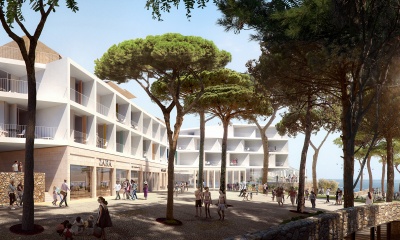
    When designing the Durres Beach Hotel in Golem, Albania, CITYFÖRSTER faced the challenge of creating quality within an unpromising context. Golem, a popular beach resort, enjoys a prime location on the sea and is set in a mountainous landscape. However, the village has suffered from uncontrolled development, resulting in a sprawling blanket of buildings. The site for the new hotel is located in the third row from the beach and faces a highway on the other side.

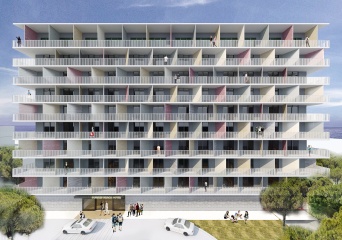
    On the other hand, the site boasts a beautiful forest of mature Mediterranean pine trees and forms an anchor to a potential urban plaza in the south. In order to overcome the challenges, we designed a building rooted in the Modernist tradition, a compact building-block surrounded by greenery. This layout provides the entire building with light, air and space, and secludes the rooms on lower floors from their direct surroundings. An elevated roof garden compensates for the footprint and adds to the overall quality of the new hotel.

    All rooms have highly finished interiors, as well as balconies offering different views – either towards the sea, towards the mountains, or towards the trees. Each balcony is cladded in natural stone from different regions in Albania, which creates a distinct rhythm in the façade. The west façade corresponds to the adjacent buildings, whilst the east façade follows the patterns of trees. The end result is a positive eyecatcher, clearly visible from the highway and the sea.
    completed
    2017
  • Orange Headquarters Mali, Bamako

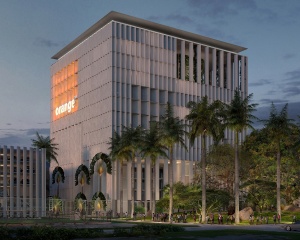
    Bamako is in a phase of rapid urban development, with the population growing expansively; telecommunications are an integral part of this growth and are a marker for upward social mobility. The height, visibility, and clean volume of the new Orange Mali Headquarters express this situation, thus creating a landmark for the new, mobile urban class.

    At the same time, the building sets the bar for offices and urban planning in Bamako, by creating a zero-energy building that incorporates greenery and improves the working environment of the Orange employees. The new Orange HQ is surrounded by a public garden, a layout that makes the office building more accessible and simultaneously creates a social space for gatherings and events. The green spaces continue into the interior of the new office building as a sequence of open terraces. By using 'stacked' office floors, and by interspacing these with high-quality open spaces, employees feel more connected and floorplans can be optimized.

    The iconic, geometrical 'zig-zag' exterior is the result of a smart and site-specific design, avoiding direct sunlight on the facade.

    in progress
    2019
  • Embassy Residences, Tirana

    How to organize attractive family living and low energy housing in a high-density city center?

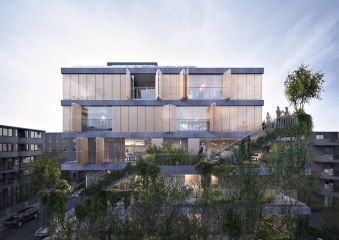
    Our award-winning design for the Embassy Residences in Albania provides high-quality, family-friendly, and low-energy housing units in the city center of Tirana, one of the fastest-growing cities in Europe.

    The project responds to the mayor's ambition to limit the growth of the city and to counter sub-urban developments with a more diverse range of housing typologies. On top of a commercial plinth and two parking levels rises a series of stacked villas, connected by a semi-public stair. This serves as alternative circulation and additional, shared informal outside space to the apartments. 


    The floorplans protect the privacy of the apartments but allow residents to sit on their porch or use the staircase to access their apartment when in the mood for a chat or a Friday afternoon drink. Research has led to a compact build-up of irrigated substrate layers that can support rich vegetation on the stair, balconies, and roof terraces.

    The facade consists of two layers arranged according to insolation. A basic glass layer is protected by a secondary shading layer of anodized aluminum where it is not protected by surrounding buildings or cantilevering volumes. This results in high transparency on the one and low energy costs on the other hand in addition to preventing the building from the hot Mediterranean sun whilst still guaranteeing an elegant look.

    under construction
    2018
  • Nivica - A model for rural development in southern Albania, , Nivica

    In the beginning of May 2018 students and professionals from Albania and the Netherlands went on a trip to Nivica, exploring the village and the region, and drafting first ideas. The team included architects, urban planners, archaeologists, landscape architects and architectural historians. The workshop results built the foundation for the further development of a masterplan for Nivica.

    The goal of this masterplan is to develop a model for a sustainable and prosperous rural economy, with touristic potential within Albania but also on an international scale. As a Living Lab, Nivica allows to experiment with alternative forms of (slow) tourism, small scale investment, renewable energy and local food and waste chains. The masterplan combines the preservation of buildings and structures related to the rich history of the region with a sustainable, diverse expansion of the touristic potential.
    Nivica is meant to be the prototype for Albania's "100 villages" plan, which sets out to fundamentally rethink rural development in the country


    Idea
    2017