ul class="overview_list " id="projectList">
  • Green Forum, Munich

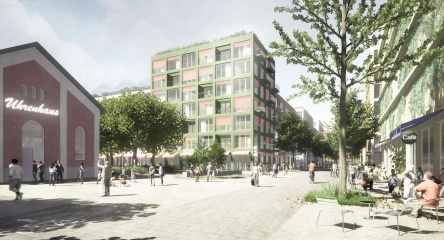
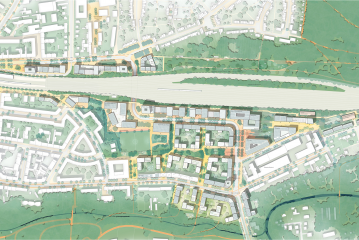
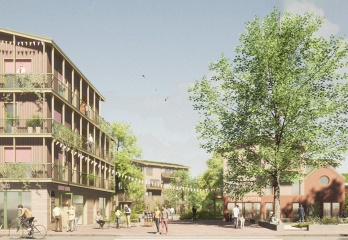
    The concept identifies three potential areas for careful urban extension: two urban neighbourhoods adjoining Feldmoching and Ludwigsfeld, and one landscape-oriented neighbourhood north of the Fasanerie. Areas of high landscape value such as Feldmoching North/West, the Obermoos and the Schrederwiesen remain undeveloped. The new neighbourhoods connect sensitively to the existing urban fabric, with open spaces acting as linking elements. A broad range of housing types strengthens social mix and creates long-term perspectives for existing residents. Local supply facilities as well as new social and educational infrastructure complement areas that are currently underserved.

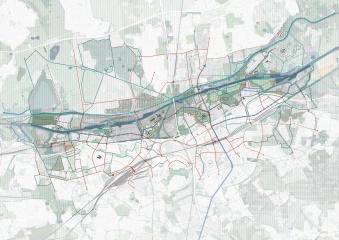
    The mobility concept relieves existing neighbourhoods by prioritising public transport, cycling and walking. The "Landscape Tram" connects neighbourhoods and recreational destinations with the regional public transport network, while compact districts offer additional options such as car sharing, bike sharing and micro-mobility.

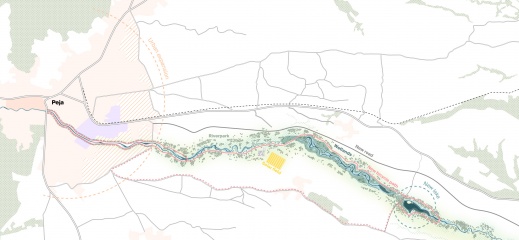
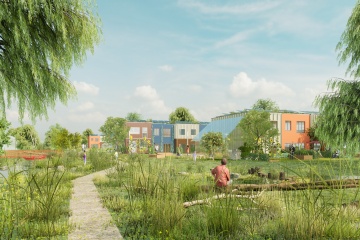
    The landscape concept builds on the productive character of the moor and heath landscape, structured by park corridors and a fine-grained network of paths. Lakes, avenues and riparian zones provide continuity and orientation. The management of rainwater and groundwater becomes a strategic component of a co-productive landscape, integrating retention areas, greywater reuse, soil-sensitive land management and rewetting strategies.

    in progress
    2024-2026
  • Centrumprogramma Papendrecht, Papendrecht

    The Cetrumprogramma Papendrecht 2040 sets a clear direction for the integrated and sustainable development of the village's heart. Strategically located in the Drechtsteden region and directly connected to the Merwede, Papendrecht Centrum offers broad opportunities.


    Through a three-phase process- from analysis to scenarios to the final program -CITYFÖRSTER and BLOC developed a participatory vision with citizens, stakeholders, and the municipality. The 2040 programma positions the centrum as a vital, green heart that unites the historic Dijkdorp character with new connections to the Merwede and the economic strength of the region.


    Key interventions include transforming the waterfront into the blue-green face of Papendrecht, developing Winkelpark De Meent into a mixed-use hub, and redesigning the oversized 1980s Market Square into a green, human-scale meeting point. Together with the municipality, long-term goals, a timeline, and project ideas provide a step-by-step path toward realizing the vision.

    The following link leads to the comprehensive booklet:

    bloc.nl/wp-content/assets/251009_pap_centrum-programma_ml.pdf

    completed
    2024- 2025
  • Saranda Underwater Centre, Sarandë

    The project has the aim of improving urban infrastructure and increasing the value of tourism assets. The city of Saranda is strategically located on the Albanian Riviera, overlooking the Ionian Sea. With its natural harbour and stunning coastal scenery, Saranda has become a central hub for tourism and maritime activities in the region.

    The underwater heritage in the south of Albania is considered by National Geographic a top 10 site for underwater archaeology. Despite this recognition, there is currently no direct activity associated with it. The establishment of the Underwater Heritage Centre not only enriches the tourism offer, but also revitalises the city's cultural heritage by repurposing the former maternity building.

    The proposed multifunctional programme integrates educational, commercial and entertainment activities to stimulate underwater tourism and connect it to the local economy and business opportunities.

    The old maternity hospital dates from the 1940s, the period of the Italo-greek wars. It shows unique architectural qualities, but remains hidden in the urban fabric. To integrate the building in the city, the entrance area is redesigned as an active urban space, and commercial functions are placed in the plinth.

    In the new roof pavilion, the building houses a new culinary venue for fine dining but also public evening events. The new rooftop restaurant establishes spectacular views over Saranda and it's coastline, while at the same time upgrading the old heritage building into a new landmark in the city.

    Idea
    2024
  • Tirana Crevices, Tirana

    Tirana Crevices—a 160-meter-tall mixed-use tower in the heart of Albania's capital, designed as a civic landmark that integrates culture, housing, work, and leisure. The design features two elegant towers with crevice-like collective spaces, providing shared amenities at intermediate levels that act as public breaks in the vertical city. Designed in partnership with LOLA Landscape Architects, the ground floor is elevated, creating a public landscape of rocks and water that engages the surrounding neighborhood, while the building's façades are clad in locally sourced natural stone, with distinct materials highlighting the communal areas and reinforcing their programmatic significance.

    The design introduces a composition of two elegant towers placed on a cityscale four-floor plinth, each structured as stacked blocks with equal proportions.These blocks are subtly shifted creating crevices —communal spaces that offer a civic and social dimension throughout the vertical structure.

    To enhance public integration, the building is lifted from the ground, creating a generous landscape beneath it—an open space inspired by rocks and water, developed in collaboration with LOLA Landscape Architects. This gesture grounds the building in its context and invites the public into the site, making the project not only a residential development but also a new urban anchor.

    in progress
    2024
  • Intergrated Tourism Masterplan for Dushanbe, Dushanbe

    The overall objective of the assignment is to develop a Tourism Master Plan for the Tourism Development Area (TDA) of Dushanbe and surrounding areas that is seamlessly integrated with plans for national, regional, and urban development, including relevant legal and regulatory requirements, sociocultural and environmental safeguards, financing needs and modalities, and assessment of economic viability of proposed investments along with more detailed pre-feasibility studies on the highest-priority individual projects. To achieve the overall objective, the following specific objectives are established:

    1. Conduct a comprehensive Strategic Analysis for tourism development in Dushanbe, including tourism demand and marketing mix fundamentals of tourism clusters, supporting factors and resources for destination competitiveness and sustainability, infrastructure and urban services in tourism clusters, regulatory/planning framework, sociocultural and environmental impacts.

    2. Develop a Tourism Master Plan for Dushanbe based on its key success factors as international destination, defining strategic framework, spatial tourism planning, a governance structure for tourism development, high-level development plans in critical components of tourism competitiveness and sustainability, sociocultural and environmental safeguards, and investment plan with the prioritization of the proposed projects.

    3. Prepare Concept Papers for the highest priority investment projects, including description, rationale, scope, and expected impacts.

    completed
    2024
  • Meidline, Vienna

    Our design proposal for a pedestrian bridge competition in Meidling, Vienna, transforms the district by combining urban design, nature, and community. The task was to link the new security center development, with 4,000 employees located north of the highway and train tracks, to the tram station in Meidling to the south.

    Instead of simply building a linear connection, we envisioned the bridge as a floating public space that reclaims underutilized infrastructure. Spanning roads and railways, the design connects existing parks, creating a cohesive green corridor. At its heart is an elevated public square- a vibrant space featuring green areas, a nature-inspired playground, a sports zone, and a café with views of Vienna.

    This „hijacking infrastructure" approach reimagines the site not as a gap to bridge but as an opportunity to enhance engagement, recreation, and ecological richness in the surroundings. The design incorporates native trees, water-permeable surfaces, and rainwater management to improve its environmental footprint. Parks like Theodor-Körner-Park and Kasernenpark are unified under the MeidLine vision, offering complementary activities while enhancing space for greenery and biodiversity.

    A participatory development process ensures the local community helps shape the final space, which could host events, markets, and performances. By prioritizing green infrastructure and flexible urban design, the MeidLine not only connects but revitalizes. This project demonstrates how underutilized infrastructure can catalyze social cohesion and environmental restoration, creating a greener, more dynamic future for rapidly growing cities like Vienna.

    Renders by: The Big Picture

    Idea
    2024
  • Neighbourhood Island Heiterblick, Leipzig

    Large-scale networked, small-scale mixed and circularly organised - this is how we envisage the future urban expansion of the growing city of Leipzig. The landscape and urban space of Heiterblick-Süd is characterised by typologically very different settlement clusters within an open space shaped by woodland and agriculture. The design takes up this existing structure and supplements it with another compact and mixed neighbourhood embedded in a flowing and interconnected landscape - the neighbourhood island Heiterblick.


    The landscape of the Paunsdorfer Bogen is continued both to the north and south and linked with the forest and field areas to the east of the motorway. The compact neighbourhood contour folds inwards and creates green fingers that act as climate corridors and ensure effective air exchange within the neighbourhood. This creates a total of five clusters that overlap in the centre and form a bundled, central district hub with a wide variety of uses. In addition to the common centre, five green squares will create a hub and meeting points for the various neighbourhoods. These will have clear addresses and different characters. The individual neighbourhoods each have their own mix of different residential building typologies, while the centre of the district is characterised by a vertical mix of uses and public ground floor zones. The focus here is on communal and sufficient forms of living.

    completed
    2024
  • Landscape Campus, Flensburg

    At Campus Flensburg the landscape takes center stage. The site, which is shared between the European University Flensburg (EUF) and the University of Flensburg, features areas of dense urban structures juxtaposed against expanses of undisturbed nature. Because of its proximity to the town's centre, the campus constitutes an important site for enabling citizens' access to nature, as well as a social space and a logistical link for students. Our design acknowledges this, and despite expanding the campus to accommodate more students and add new uses, no additional land is sealed.

    The plan was developed through a cooperative workshop procedure together with our team-mates at TREIBHAUS. It embraces the different urban planning qualities of the two universities and the connecting landscape park as well as the needs of all stakeholders, locating shared facilities for all users at the heart of the campus. A central element of the design is the campus loop, which serves as an important pedestrian route across the campus while also facilitating orientation. This path is complemented by the garden loop, a greener route creating connections to the open spaces and the surrounding area.

    The overall campus design observes holistic principles of sufficiency and circularity; requirements for buildings, infrastructure and parking spaces are critically scrutinised, while sustainable mobility and energy solutions go hand in hand with integrated design to ensure that resources are efficiently shared and reused. The consistent development of ground-level parking and a strategy of redensification preserves the defining quality of the campus to be preserved - its green, open landscape.

    in progress
    2024
  • Henschel Quarter, Kassel

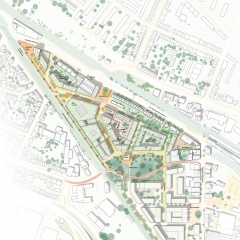
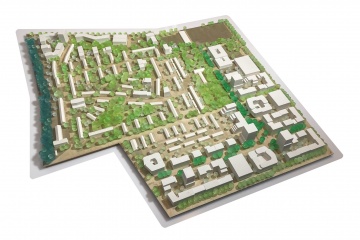
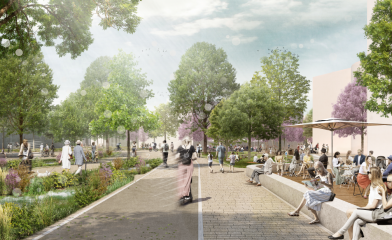
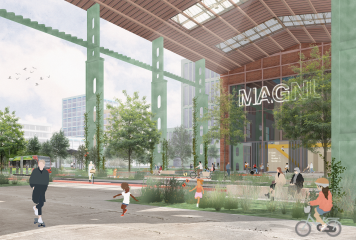
    The Henschel Quarter opens up hertitage sites to the public and secures them through flexible use. It is integrated into the city and is accessible to everyone. The aim is to preserve the historic industrial culture and make it usable. Listed buildings are carefully restored and remain part of the public space. The industrial past will be preserved through minimally invasive interventions, while new and predominantly commercial uses will revitalize the old halls. The open space will be transformed, historical traces such as tracks and crane runways will be preserved, supplemented by green spaces and playgrounds. In terms of urban planning, small-scale building typologies create the transition to adjacent districts, while high points mark important locations. Connections for pedestrians and cyclists create a continuous and close-knit network in the district. The existing buildings will be supplemented by new buildings whose design is based on the industrial character. Historic parts of the buildings will be retained and partially integrated into the outdoor space. In the center of the quarter, a "hall for all" with restaurants, culture and sports will be created, surrounded by creative and commercial uses.

    The Henschel Quarter focuses on sustainability by preserving the existing buildings and reusing gray energy. Demolition materials are recycled on site and new buildings are constructed from sustainable materials. Renewable energies such as solar panels and geothermal energy supply the quarter, while open spaces improve the microclimate, and the combination of history, commercial, cultural and innovative offerings makes the Henschel Quarter a vibrant part of Kassel.

    completed
    2024
  • At home in Gutleut-West, Frankfurt a. M.

    What potential does Frankfurt's city centre have for conversion and sustainable inner city development? The Gutleut district in the heart of Frankfurt has so far been an infrastructurally characterised transit area and largely isolated from the nearby banks of the Main. The concept pursues the vision of transforming the area into a productive city and combining urgently needed affordable housing with urban production and new neighbourhood infrastructure. Gutleutstrasse becomes a climate strip and connects the north and south of the neighbourhood as a linear open space. Green axes connect the neighbourhood with the water. Public and residential facilities such as a school, daycare centre, local supermarket and neighbourhood meeting point ensure frequency and short distances. Institutional spaces such as the sports hall and theatre open their doors to the neighbourhood.
    The banks of the Main will be designed as a sports and recreational area and, together with the Klimastrip, will create a new blue-green neighbourhood character. In the overarching urban context, Gutleut-West will in future follow the guiding principle of a high-contrast, loosened-up and green urban landscape. Striking landmarks such as the power station and the water reservoir characterise the cityscape and mark the transition to the city centre. The central idea of 'infrastructure as a lever' illustrates the transformative potential of human-centred infrastructures. Such infrastructures go beyond their original, purely technical function and create the conditions for positive social developments. They offer the opportunity to attract interesting stakeholders from different areas and thus create synergies that radiate far beyond the built environment.

    completed
    2024
  • Urban Village Lörick, Düsseldorf

    How can the quality of living and lifestyle of a city and village be combined? The urban village Lörick combines characteristics that are classically described as 'urban', such as high urban density, a mix of uses and good infrastructure, with those of 'village' coexistence, such as neighbourhood identities and a direct connection to green spaces. This makes it a meaningful and integrated addition to the Düsseldorf district of Lörick, which is characterised by the contrast between urban and village structures.
    The landscape and urban design concept picks up on the historically anchored field structures developed over decades, which still characterise and surround the planning area today. The landscape was successively divided into strips of different widths with a north-south orientation and thus cultivated over the years. This existing structure is taken up spatially and transformed to meet the requirements of an urban village. Analogous to the north-south orientated field structures of the surrounding landscape, differently programmed 'field strips' are created that accommodate buildings and open space uses. Each building is given as large an intersection as possible with a green strip characterised by the landscape, so that the desire to live in the countryside is addressed despite the high urban density.

    completed
    2024
  • Exhibition: How do we want to build?

    The historic port area of the Merwevierhavens (M4H) in Rotterdam will soon begin an extensive redevelopment. Once deeply embedded in the maritime world of the Port of Rotterdam, the area is now transitioning towards new futures. Industry is moving away, and new developments will transform the area towards into a vibrant mixed-use urban district. The planning framework envisions a circular economy, smart mobility and sustainable energy concepts, among other things.

    Faced with the prospect of this change, Keilecollectief took the opportunity to ask itself "How do we want to build in the future?" This exhibition is a co-production of answers and further questions. It explores building cultures of the past, present and possible futures. The question is dissected into the themes of architecture, materials, urbanism, and landscape.

    The question, "How do we want to build?" or rather, "How do we want to build cities?", inevitably entails the bigger question of "How do we want to live in future cities?" Cityförster's contribution to the answer is twofold. Over a historical-to-speculative timeline of 1900-2050, we worked to analyze the relations between socio-economic trends, spatial policy and iconic societal developments. Through this work it becomes clear that policy is always dictating a certain quality and style of life.

    During the 20th century we observed the rise and increasing friction of our economy of growth, and how this resulted in the enormous climate impacts we are experiencing today. On the other hand, our research into four case studies reveals how urban factors such as the urban fabric, density and space ratios all impact our way of life. The study shows that high-density inner-city neighbourhoods are most cost-efficient, while also hinting that these neighbourhoods and their residents may generate lower ecological footprints.

    Looking to the future, we propose spatial planning based on "sufficiency"; a rationale of urban design for a lifestyle of enough, instead of surplus. Owning less and sharing more is a key principle for community-based design, and future urban design should consider this at its core. With compact homes, biobased buildings and shared facilities, future cities should enable a sustainable lifestyle for all residents. This rationale, which reduces emissions of buildings, cities and residents, is what we call Carbon-Based Urbanism.

    The exhibition was on public display from June 15 until September 15 2024 in Keilepand, Rotterdam, and was accompanied by a supporting programme filled with guided tours, open days, presentations, debate nights, movie screenings and serious games. Through this work, Cityförster contributes to the discourse about building practices in the Netherlands. The exhibition was a co-production with Keilecollectief, Group A/CarbonLab, Happel Cornelisse Verhoeven, De Urbanisten and Studio Adams, and was supported by Stimuleringsfonds Creatieve Industrie, Gemeente Rotterdam, Programmabureau M4H, AIR Rotterdam, Cordeel, Vandersanden, and Dura Vermeer Bouw Heyma.

    Idea
    2024
  • Landesbehördenhaus, Bonn

    The site of the former state authority building is located in the framework plan area of the federal district in Bonn. In the „Laboratory" area of specialization, this formulates a diverse mixed quarter with a residential focus for the site. Following a study on the distribution of use and building mass, an urban development framework plan was drawn up in 3 urban development variants.
    This involves the preservation of two existing buildings with a gross floor area of around 45,000 m², the demolition of which had actually already been decided. Two urban residential courtyards and two high-rise buildings with a plinth level complement the existing „Liegende-8" and „L-building" to create a quarter with clearly defined urban spaces and, together with the green forum, form the robust basic structure.

    To the north, a 120m high-rise building with the Secure Digital City Campus (SDC) and additional office space in the base leads across the opening square into the center and into the quarter. Privately financed residential housing is planned above the base. The counterpart to the high-rise building is the hybrid usage module at the southern corner with a three-storey primary school and daycare base and a small residential high-rise (max. 40 m), which houses subsidized apartments for students and trainees. The schoolyard is located under the existing trees along Nahum-Goldmann-Allee, while the outdoor daycare area is located on the roof of the base level.
    One storey will be added to Liegende-8 in lightweight construction, accommodating the local supplier in the northern section and otherwise being used entirely by the city administration. The first floor areas form a generous arcade towards the green center and the 120m high-rise building. Two spacious residential courtyards (including the existing L-building) with active first floor uses towards the center (gastronomy & retail) complement the existing „Liegenden-8" to create an urban quarter.

    in progress
    2024
  • Georgia: an infrastructure gap analysis for selected sites

    This project involves a detailed public infrastructure gap analysis and the creation of an action plan for the development of two pilot sites in Georgia: Samshvilde in Kvemo Kartli and Pikalebi in Kakheti. Samshvilde is known for its archaeological and cultural heritage, while Pikalebi is historically significant as Kakheti's gateway.

    The plan aims to unlock the tourism potential of these sites, minimize environmental impact, and engage stakeholders and the local community inclusively. It includes budget estimates for the necessary public investments in both locations.

    Key project tasks encompass public infrastructure assessment, community engagement, social impact assessment, and stakeholder mapping. The report identifies development challenges and opportunities for both sites, stressing the importance of strategic planning and community involvement.

    For Samshvilde, the focus is on improving roads, drinking water, and sewage systems while preserving the village's character and enhancing public spaces. For Pikalebi, the report suggests a dispersed design approach inspired by the „Albergo Diffuso" concept to maintain the area's natural beauty and integrate hotel infrastructure with the environment.

    Overall, the action plan seeks to transform Samshvilde and Pikalebi into vibrant, sustainable tourist destinations while protecting their cultural and natural heritage for future generations.

    completed
    2024
  • High Q, Hanover

    Urban integration creates a neighborhood
    In its immediate surroundings, HIGH Q picks up on the typological and urban development characteristics of its neighborhood. The existing principles of block structures, incisions and polygonal high points are transferred to HIGH Q in order to create a harmonious overall urban image.
    On the west side of the construction site, a neighborhood square with outdoor gastronomy will be created at the interface between the office and the hotel, creating a lively meeting place for everyone. This square also serves as an entrance to the hotel lobby.

    Striking appearance creates identity
    Whether viewed from a passing train, as a pedestrian or from a bicycle, the HIGH Q always looks different and yet is unmistakable. The special façade design with 6 partial façades makes the high-rise appear slender and without a rear side, creating ever new impressions.

    Recognition value and an identity-creating design are an important requirement for this building in this exposed location. On the one hand, the façade and the striking shape create a variety of impressions depending on the viewing angle, while on the other hand the building also offers diverse and special situations in its immediate context. The undercut to Celler Strasse with its forecourt forms a clear address, the neighborhood square offers a common center for the neighborhood and the differently designed facades improve orientation and create different places.

    Idea
    2024